Best Camping Knives 2026 — Lightweight, Reliable, Affordable
Choosing a camping knife comes down to a handful of real tradeoffs: fixed vs. folding, blade steel, size and weight, and how you plan to carry it. There’s no single “best” answer — it depends on what kind of camping you actually do. Here’s how to think through the decision honestly.
Fixed Blade vs. Folding Knife
A fixed-blade knife has no moving parts, which means no hinge to loosen, no lock to fail, and generally more strength for hard tasks like batoning wood or prying. That makes fixed blades the go-to choice for bushcraft-style camping where you’re processing firewood or doing heavier cutting. The downside is bulk — a fixed blade needs a sheath and doesn’t tuck into a pocket.
A folding knife is more compact and easier to carry day-to-day, which suits car camping, backpacking where every ounce and inch of pack space matters, or campers who mostly need a knife for food prep and light cutting tasks. Modern folders with a solid lock (liner lock, frame lock, or back lock) can handle plenty of camp chores, but they’re still not as robust as a full-tang fixed blade for chopping or batoning.
Blade Length and Steel
For general camp use — food prep, cutting cordage, whittling kindling — a moderate blade length is more versatile than an oversized one. Very long blades add weight and are awkward for fine tasks; very short blades struggle with batoning or larger cutting jobs. Match the blade to what you’ll actually use it for.
On steel, the tradeoff is usually toughness and ease of sharpening versus edge retention and corrosion resistance. Simple carbon steels (like 1095) sharpen easily in the field and hold up to abuse but need to be kept dry and lightly oiled to avoid rust. Stainless steels (like 420HC or 8Cr13MoV on budget knives, or higher-end options like VG-10) resist corrosion better, which is useful in humid or wet environments, but can be a bit more work to bring back to a fine edge without proper tools. Neither is objectively “better” — it depends on your climate and how diligent you are about maintenance.
Weight vs. Durability
Thicker blade stock and full-tang construction add strength and durability but also add weight — a real consideration if you’re backpacking rather than car camping. Ultralight backpackers often carry a small, lightweight folder or even a minimalist fixed blade and accept some limits on what it can do, while car campers and bushcrafters can afford a heavier, more capable knife since weight isn’t as much of a constraint.
Sheath and Carry Options
For fixed blades, look at how the sheath carries: leather sheaths look classic and mold to the knife over time but need occasional conditioning, while kydex or nylon sheaths are more weatherproof and often include options for different carry positions (belt, pack strap, or MOLLE-compatible mounting). For folders, a sturdy pocket clip or a small belt pouch keeps the knife accessible without digging through a bag.
Multi-Tool vs. Dedicated Knife
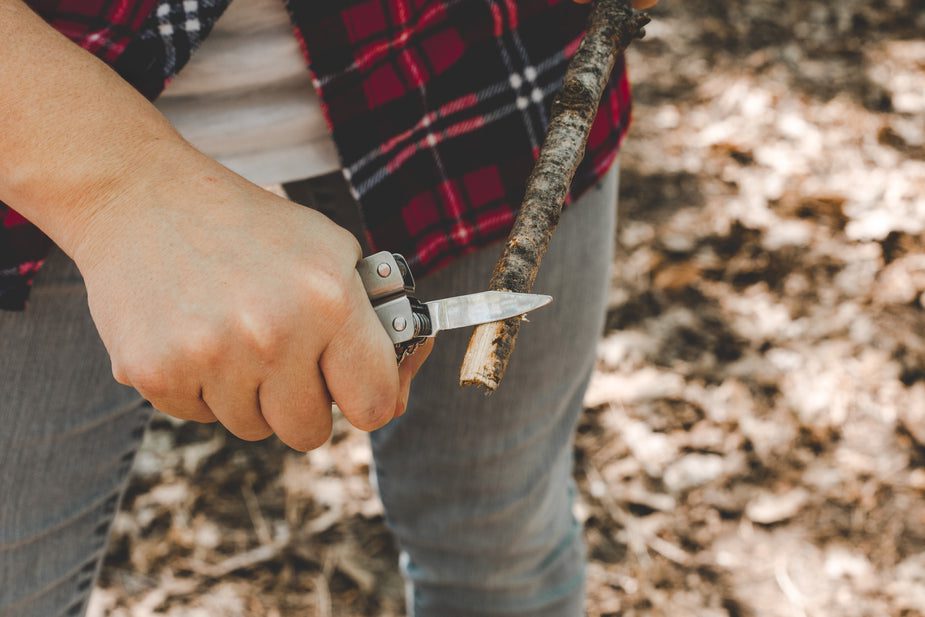
Multi-tools are appealing because they pack pliers, screwdrivers, and other implements into one unit, which is handy for gear repairs and odd jobs around camp. But the knife blade on a multi-tool is almost always a compromise — shorter, harder to sharpen well, and less comfortable to grip for extended cutting. Many experienced campers carry both: a dedicated knife for actual cutting tasks and a separate multi-tool for mechanical fixes, rather than relying on one tool to do everything adequately.
Bottom Line
There’s no universal best camping knife — there’s a best knife for your style of camping. Backpackers should lean light and simple, bushcrafters and basecamp campers can justify a heavier full-tang fixed blade, and most car campers land somewhere comfortably in the middle with a mid-size folder or fixed blade in a stainless steel that shrugs off moisture without much fuss.
A Few Real Camping Knives Worth Comparing
| Knife | Type | Price Tier | Best For |
|---|---|---|---|
| Morakniv Companion | Fixed blade | Budget ($15-25) | Lightweight backpackers who want a simple, sharp, disposable-cheap fixed blade |
| ESEE-4 | Fixed blade | Mid ($130-150) | Bushcrafters and basecamp campers who want a full-tang knife built to baton |
| Benchmade Bugout | Folder | Premium (~$180) | Backpackers who want an ultralight folder that still handles real cutting tasks |
| Opinel No.8 | Folder | Budget ($15-20) | Car campers who just need a simple, comfortable knife for food prep |
Check Morakniv Companion on Amazon · Check ESEE-4 on Amazon · Check Benchmade Bugout on Amazon · Check Opinel No.8 on Amazon
This article may contain affiliate links. If you purchase a product through one of these links, Bladeowl may earn a commission at no extra cost to you. This never influences our editorial independence or which products we recommend.