EDC Knife Opening Mechanisms Compared – Flipper vs Thumb Stud vs Hole vs Automatic
The Evolution of Opening a Knife
For something as simple as “getting the blade out,” knife designers have spent decades refining opening mechanisms into an art form. What started as a simple nail nick on traditional slipjoints has evolved into a landscape of thumb studs, flipper tabs, deployment holes, automatic mechanisms, and hybrid designs that blend multiple approaches. Each mechanism has its own personality, advantages, and trade-offs. Understanding them helps you pick the right knife for your hands, your habits, and your local laws.
We’ve tested hundreds of knives across every deployment method, and here’s what we’ve learned: the “best” opening mechanism isn’t universal — it’s the one that fits how you actually use a knife. Someone who opens their knife 50 times a day on a construction site has different priorities than someone who pulls it out twice a week to open Amazon packages. Let’s break down each type.
Thumb Stud
How it works: A small metal peg mounted on the blade near the pivot. You push against it with your thumb to rotate the blade open.
Pros: The thumb stud is the most common deployment method for good reason. It’s intuitive — even someone who’s never handled a folding knife can figure it out in seconds. Thumb studs work equally well for slow, controlled opening (useful around non-knife-people) and fast deployment when needed. They’re ambidextrous when mounted on both sides of the blade. And unlike flipper tabs, they don’t create a protrusion from the handle when the knife is closed.
Cons: Thumb studs can be hard on your thumb during extended use, especially on knives with strong detents. If you’re opening the knife 100+ times a day, a thumb stud can eventually create a sore spot. The stud itself adds a small amount of width to the blade, which can slightly interfere with cutting on flat surfaces — though in practice, this rarely matters for EDC tasks.
Notable examples: Benchmade Griptilian and 940 series, Ontario RAT 1 and 2, CRKT M16 series. The Ontario RAT 2 in particular has one of the best thumb stud actions we’ve ever felt on a budget knife — smooth, reliable, and perfectly positioned.
Flipper Tab
How it works: A protrusion on the back of the blade tang extends past the handle when the knife is closed. You press down on this tab with your index finger, and the blade rotates open — usually on ball bearings for smooth, fast deployment.
Pros: Flippers are fast. Really fast. A well-tuned flipper on bearings fires open with authority and a satisfying “thwack” that never gets old. The motion uses your larger index finger muscles rather than your thumb, which some people find more comfortable for repeated use. Flipper tabs also serve as a finger guard when the blade is open — that tab sits in front of the handle, preventing your hand from sliding forward onto the cutting edge.
Cons: That same protrusion that makes deployment fast also makes the knife bulkier in pocket. The flipper tab is always there when the knife is closed, and depending on the design, it can catch on your hand when reaching into your pocket. Flippers also tend to be more threatening-looking to non-knife-people — the fast, one-handed deployment can raise eyebrows in office settings. And if the detent is too weak, a flipper knife can partially open in your pocket, which is a safety concern.
Notable examples: Civivi Elementum (the flipper version), Zero Tolerance 0450, Kershaw Leek. The Elementum is the standard-bearer for flipper action in the $50 price range — smooth bearings, perfect detent, and a satisfying deployment every time.
Thumb Hole (Spydie Hole)
How it works: A round hole in the blade near the spine, popularized (and trademarked as a round hole) by Spyderco. The hole serves the same function as a thumb stud — you push against its edge to rotate the blade open — but also enables the “Spydie flick,” where you use your middle finger to flick the blade open from the back.
Pros: The thumb hole is remarkably versatile. Slow roll-open with your thumb, fast flick with your middle finger, or even a reverse flick with your index finger — the hole accommodates multiple deployment styles. Unlike a thumb stud, the hole doesn’t protrude from the blade, so it never interferes with cutting. It also works with gloves better than most thumb studs, especially the larger holes on knives like the Spyderco Manix 2.
Cons: The hole creates a weak point in the blade, especially on models with large holes relative to blade width. There’s a reason Spyderco uses a trademarked Round Hole — the exact diameter, placement, and edge-breaking on the hole is critical to avoid stress risers. Knives that use a generic hole without Spyderco’s engineering behind it can develop cracks. The hole also requires some practice to use smoothly — a new Spyderco user often fumbles with the Spydie-flick for a few days before mastering it.
Notable examples: Spyderco Para 3, Paramilitary 2, Delica 4, Manix 2. The Para 3’s compression lock combined with the thumb hole is arguably the most fidget-friendly non-button-lock setup on the market.
Automatic (Switchblade / OTF)
How it works: A spring-loaded mechanism fires the blade open at the press of a button or slide. Out-the-front (OTF) autos deploy the blade straight out the front of the handle. Side-opening autos pivot the blade like a traditional folder, driven by a coil spring.
Pros: Nothing beats an automatic for raw speed and one-handed operation. If you’re wearing heavy gloves, have limited hand dexterity, or need to deploy a knife in an emergency situation, an automatic is the fastest option available. OTF knives are also inherently ambidextrous and symmetrical in design, which left-handed users appreciate.
Cons: Legality is the biggest issue. Automatic knives are restricted or banned in many states and countries. Even where they’re legal, carrying one comes with social baggage — a switchblade still carries a stigma that a thumb-stud knife doesn’t. OTFs also have inherent blade play by design (the blade needs clearance to slide freely), which feels sloppy if you’re used to a tightly toleranced manual folder. And automatic mechanisms add complexity and potential failure points — springs can break, dirt can jam the firing mechanism.
Notable examples: Microtech Ultratech (OTF), Benchmade Infidel (OTF), ProTech TR-3 (side-opening auto). ProTech is widely considered to make the best side-opening automatic knives in the world, with actions that fire harder than any other production auto.
Front Flipper
How it works: Similar to a standard flipper, but the tab is located on the top/front of the blade rather than the back. You deploy it by rolling your thumb over the top of the knife rather than pressing down with your index finger.
Pros: Front flippers eliminate the pocket-snagging protrusion of a standard flipper while keeping the fast deployment. The thumb-rolling opening motion is also less aggressive-looking than an index-finger flipper — it’s closer to the slow-roll opening of a traditional knife, just faster. When the knife is open, there’s no flipper tab acting as a finger guard, which some people prefer for certain cutting grips.
Cons: Front flippers have a steeper learning curve than any other deployment method. Getting reliable deployment requires precise thumb placement and the right amount of pressure at the right angle. New users frequently fail to fully deploy the blade, resulting in a “half-open” condition that’s actually more dangerous than a fully deployed blade. Front flippers also need a relatively strong detent to work reliably, which conflicts with the smooth closure that many people want.
Notable examples: Kizer Feist, Boos Blades Smoke, Civivi McKenna. The Feist was one of the knives that popularized the front flipper in the production market, and it remains a reference design for the mechanism.
Nail Nick
How it works: A small cutout or groove in the blade that you catch with your thumbnail to pull the blade open. The traditional opening method used on slipjoints and Swiss Army Knives for over a century.
Pros: Nail nicks are completely inoffensive. There’s nothing threatening about the slow, two-handed opening of a traditional slipjoint, which makes these knives legal virtually everywhere and socially acceptable in any setting. The lack of a locking mechanism (most nail-nick knives are slipjoints) also means they’re legal in places like the UK where locking knives face heavy restrictions.
Cons: Slow, requires two hands (or at least some manual dexterity with one), and impossible to open with gloves. The nail nick itself can be hard to catch if your nails are trimmed short. And on traditional slipjoints with strong backsprings, the pull weight can be significant — we’ve handled some GEC knives with pulls heavy enough to break a thumbnail.
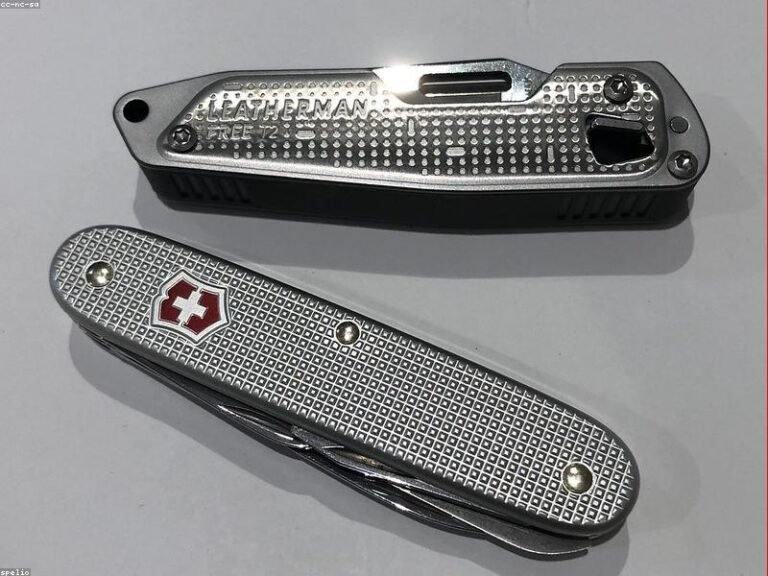
Notable examples: Case Trapper, Victorinox Swiss Army Knives, Great Eastern Cutlery (GEC) slipjoints. The Victorinox SAK is the most carried nail-nick knife in the world, and for good reason — it’s the most socially acceptable knife you can carry.
Comparison Table
| Mechanism | Speed | One-Handed | Ambidextrous | Pocket-Friendly | Learning Curve | Social Acceptability |
|---|---|---|---|---|---|---|
| Thumb Stud | Fast | ✓ | If dual-sided | Excellent | Easy | Good |
| Flipper Tab | Very Fast | ✓ | Usually | Fair (protrusion) | Very Easy | Fair |
| Thumb Hole | Fast-Very Fast | ✓ | Yes | Excellent | Moderate | Good |
| Automatic | Fastest | ✓ | Yes | Good | Easiest | Poor |
| Front Flipper | Fast | ✓ | Usually | Excellent | Hard | Good |
| Nail Nick | Slow | ✗ | Yes | Best | Easy | Best |
One Representative Knife Per Mechanism
Reading about a mechanism only gets you so far — here’s one specific, widely available knife for each deployment style so you can see (and feel) the difference for yourself.
| Knife | Mechanism | Price Tier | Best For |
|---|---|---|---|
| Benchmade Griptilian | Thumb Stud | ~$130-150 | First-time buyers who want an intuitive, ambidextrous deployment |
| Civivi Elementum | Flipper Tab | ~$45-55 | Fidgeters who want fast, satisfying bearing-driven deployment on a budget |
| Spyderco Para 3 | Thumb Hole | ~$150-170 | EDC users who want a versatile, gloves-friendly, socially low-key opener |
| Kershaw Launch 4 | Automatic (Button Lock) | ~$90-110 | Where legal — users who need the fastest possible one-handed deployment |
| Victorinox Swiss Army Knife | Nail Nick | ~$25-40 | Carrying somewhere locking knives or fast openers face legal restrictions |
What We Actually Carry
If you forced us to pick one mechanism for everyday carry, it would be the thumb hole. The Spyderco-style round hole offers the best combination of speed, versatility, pocket-friendliness, and social acceptability. You can slow-roll it open around coworkers who might be uncomfortable with a knife, or Spydie-flick it when you’re on a job site and need it fast. It’s the Swiss Army knife of deployment methods — not the best at any one thing, but good at everything.
But here’s the honest truth: after a few weeks with any knife, the deployment method becomes muscle memory. Whether it’s a thumb stud, flipper, or hole, your hand learns the motion and it becomes second nature. The bigger factor in daily carry satisfaction is usually the lock type (Axis/compression/liner/frame) and the detent tuning, not just how you get the blade out. Pick the deployment method that feels natural to your hands, and don’t overthink it.
This article may contain affiliate links. If you purchase a product through one of these links, Bladeowl may earn a commission at no extra cost to you. This never influences our editorial independence or which products we recommend.