
Wüsthof Knives: Seven Generations of Solingen Forging Excellence – The Complete Brand Spotlight
In the world of premium kitchen cutlery, Wüsthof stands apart as a family-owned company that has been forging blades in Solingen, Germany since 1814. Now in its seventh generation of family leadership, Wüsthof has maintained an unwavering commitment to traditional forging techniques while embracing modern manufacturing precision. The result is a knife that feels simultaneously timeless and contemporary — heavy in the hand in the way that inspires confidence, with edges that are sharp, durable, and easily maintained.
Seven Generations in Solingen
The Wüsthof story begins with Johann Abraham Wüsthof, who founded a small scissors and knife workshop in Solingen in 1814. The city’s grinding canals (Schleifkotten) powered the water-driven grinding wheels that gave Solingen blades their legendary sharpness. Wüsthof grew steadily through the 19th and 20th centuries, surviving two world wars that devastated German industry and emerging stronger each time.
Today, Wüsthof is run by cousins Harald Wüsthof and Viola Wüsthof, the seventh generation of the founding family. In an era of private equity acquisitions and corporate consolidation, Wüsthof’s continued family ownership is remarkable and reflects a commitment to quality over quarterly profits. Browse Wüsthof knife sets on Amazon.
The Wüsthof Lineup: Finding Your Knife
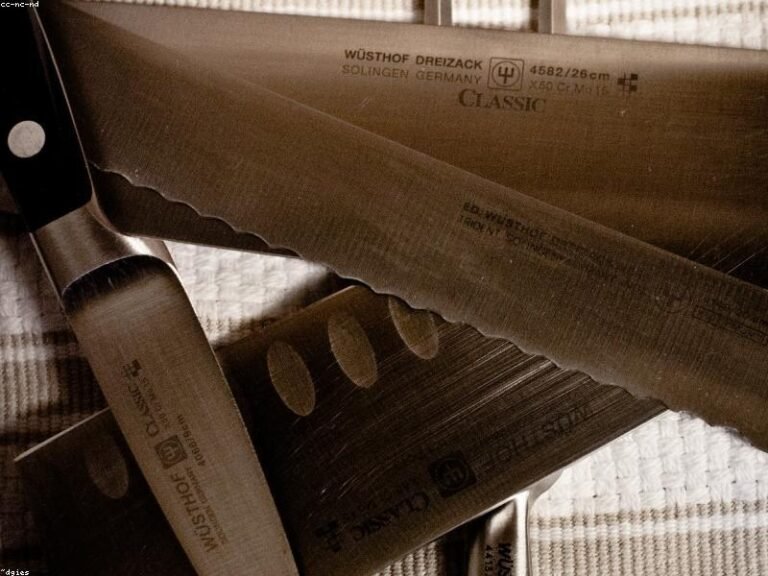
Wüsthof Classic: The quintessential Wüsthof experience and the brand’s best-selling line worldwide. The Wüsthof Classic features a full bolster (the thick junction between blade and handle), a triple-riveted POM handle in classic black, and the distinctive Wüsthof trident logo. The full bolster provides balance, finger protection, and a feeling of solidity that defines the German knife experience. The POM handle is virtually indestructible, dishwasher-safe (though hand-washing is recommended), and shaped to fit the hand naturally in a pinch grip or hammer grip.
Wüsthof Classic Ikon: An evolution of the Classic, the Ikon addresses the Classic’s main criticism: the full bolster. By using a half bolster (only on the spine side), the Ikon allows the entire edge to be sharpened from heel to tip. The handle is more contoured and uses a more premium POM material, and the rear bolster adds aesthetic balance. The Ikon is a significant ergonomic upgrade over the Classic for cooks who sharpen their own knives.
Wüsthof Crafter: A relatively new line that brings traditional materials to modern design. The Wüsthof Crafter features smoked oak handles that give each knife a warm, organic feel. The wood is treated for durability and water resistance, though it requires more care than synthetic handles. The Crafter appeals to cooks who appreciate natural materials and want their knife to have a more artisanal character.
Wüsthof Performer: The newest addition to the Wüsthof family, designed by industrial designer Björn Berger. The knife features a unique textured handle design that provides exceptional grip, even with wet or greasy hands. The blade is coated with a protective layer that reduces friction when cutting sticky foods. It’s the Wüsthof most explicitly designed with professional kitchen environments in mind. Check out the Wüsthof Performer on Amazon.
Precision Forging: The PEPtec Process
Wüsthof’s Precision Edge Technology (PEPtec) represents the company’s approach to blending traditional forging with modern precision. The process begins with a single blank of X50CrMoV15 steel, heated to over 1000°C and drop-forged under extreme pressure into the rough blade shape. Unlike stamped knives (which are cut from a flat sheet of steel), forged knives have a dense grain structure that flows with the blade’s profile, resulting in superior strength and balance.
After forging, the blades undergo over 40 manufacturing steps including precision grinding, laser-measured edge angles, and tempering for optimal hardness (HRC 58). The final edges are finished by hand on whetstones — a process that Wüsthof calls “the sharpening of the blade’s soul.” Each knife is inspected before leaving Solingen.
Wüsthof in the Professional Kitchen
Walk into any professional kitchen in Germany and you’ll likely find Wüsthof knives on the magnetic strip. The brand’s combination of durability, ease of maintenance, and comfortable ergonomics has made it a standard in culinary schools and restaurant kitchens across Europe and North America. Wüsthof knives are tools designed to work every day, not sit in a display case. They’re built for cooks who need their knife to perform through hours of prep without fatigue.
While Wüsthof knives are more expensive than mass-market alternatives, they represent excellent value over the long term. A well-maintained Wüsthof will last decades. The company’s lifetime warranty against manufacturing defects provides additional peace of mind. Shop the complete Wüsthof collection on Amazon.
This article may contain affiliate links. If you purchase a product through one of these links, Bladeowl may earn a commission at no extra cost to you. This never influences our editorial independence or which products we recommend.