How Often You Really Need to Sharpen a Survival Knife in the Field
New knife owners tend to fall into one of two camps: sharpening far more often than needed, which wears away blade steel unnecessarily, or ignoring the edge until it’s genuinely dangerous to use. Neither is right. How often a survival knife actually needs attention depends far more on what it’s cutting than on any fixed schedule, and knowing the difference between a quick touch-up and a full resharpen will save both your steel and your patience.
It’s about material, not time
Cutting soft materials — cordage, food, cardboard — is comparatively gentle on an edge. Batoning through knots, processing dense or resinous wood, digging, or contact with dirt and grit is much harder on it, since abrasive particles and impact both accelerate edge wear far faster than clean cutting does. A knife used for light camp chores over a weekend might not need anything beyond a strop. The same knife used to baton firewood and clear a shelter site over the same weekend could need a real resharpening by the end of it. Rather than “sharpen every X days,” a more useful rule is to sharpen based on what the edge has actually been through, checking it after any task that involves impact, grit, or particularly hard material rather than on autopilot.
Touch-up stropping vs. full resharpening
These solve different problems. Stropping — drawing the edge across leather or a fine abrasive with the spine leading — realigns a microscopically bent edge and polishes off light burring. It doesn’t remove meaningful metal and it’s something you can do daily without shortening the knife’s working life. It’s the right call when a blade still cuts but feels slightly “grabby” or inconsistent rather than actually blunt.
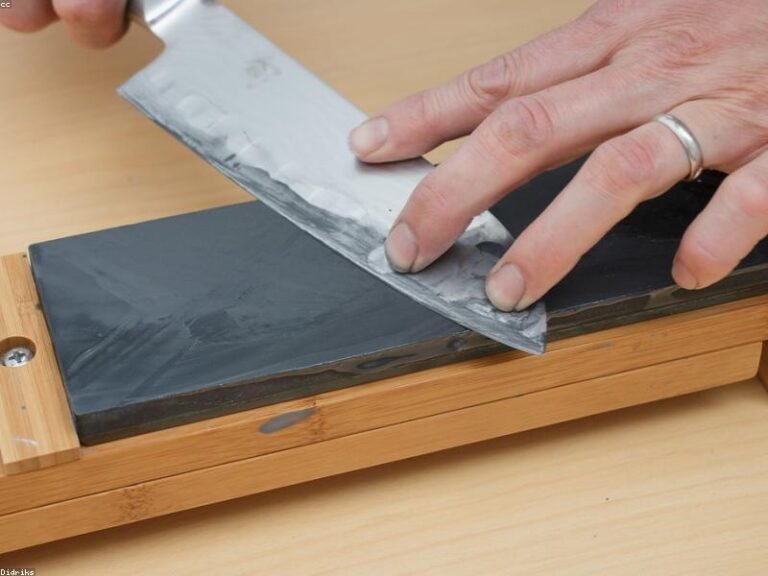
A full resharpening, working through progressively finer stones to form a new edge, is what’s needed when the edge has actually dulled — not just misaligned — usually from sustained use or contact with something abrasive or hard. This removes real material, which is why it shouldn’t be done on a schedule out of habit; it should be done when the edge condition actually calls for it. Reaching for a full resharpen every time a strop would have done the job wears down the blade’s geometry faster than necessary over the knife’s lifetime.
Reading the signs an edge needs attention
A few field-practical tests tell you more than a calendar ever will. Try slicing through a piece of paper or a thin strip of cardboard held loosely in the air — a sharp edge bites in cleanly, while a dulling one snags, tears, or needs the material braced against something to cut. Look at the edge under good light at an angle; a sharp apex shows no reflection because there’s no flat spot to catch light, while a dull or rolled edge often shows a thin bright line running along it. Feel (carefully, moving away from the edge, not into it) for a burr or rough patch, which usually means the edge has rolled rather than simply worn down evenly, and can sometimes be fixed with stropping alone. Finally, pay attention to how much force a familiar task takes compared to normal — needing to lean into a cut you used to make with light pressure is one of the more reliable practical indicators that it’s time to do something more than strop.
The takeaway
There’s no universal interval that fits every knife and every trip. Match your response to the edge’s actual condition: strop often and lightly, and reserve full resharpening for when the edge has genuinely dulled from real work. That approach keeps the knife performing well without sacrificing steel it doesn’t need to give up.