Spyderco Para 3 vs Benchmade Bugout — Which Should You Buy?
Spyderco Para 3 vs Benchmade Bugout — Which Should You Buy? (2026)
The two most compared EDC knives go head to head. Here's everything you need to know before you buy.
If you've spent more than five minutes browsing r/knives or watching Nick Shabazz videos, you've seen this debate. The Spyderco Para 3 and the Benchmade Bugout 535 are the two most recommended everyday carry knives on the internet — and they've been locking horns since the Bugout dropped in 2017. Both are American-made, both sit in the $180–$210 sweet spot, and both have cult followings that will defend their choice to the death.
But they couldn't be more different in philosophy. The Para 3 is a shrunk-down hard-use folder with a tank-like lock and zero flex. The Bugout is an ultralight that practically vanishes in your pocket but still packs a full-size blade. One feels substantial. The other feels like it's cheating physics.
I've carried both extensively — on construction sites, at desk jobs, and on weekend camping trips. Here's the honest comparison nobody's giving you.
Quick Specs: At a Glance
| Spec | Spyderco Para 3 | Benchmade Bugout 535 |
|---|---|---|
| Blade Length | 3.00″ (76 mm) | 3.24″ (82 mm) |
| Blade Steel | CPM S45VN | CPM-S30V |
| Overall Length | 7.27″ (185 mm) | 7.46″ (189 mm) |
| Weight | 3.4 oz (96 g) | 1.85 oz (52 g) |
| Lock Type | Compression Lock | AXIS Lock |
| Handle Material | G-10 (textured) | Grivory (glass-filled nylon) |
| Blade Grind | Full-flat | Flat (slight hollow) |
| Country of Origin | USA | USA |
| Street Price | ~$190 | ~$180–$210 |
Head-to-Head Breakdown

Blade Steel: S45VN vs S30V
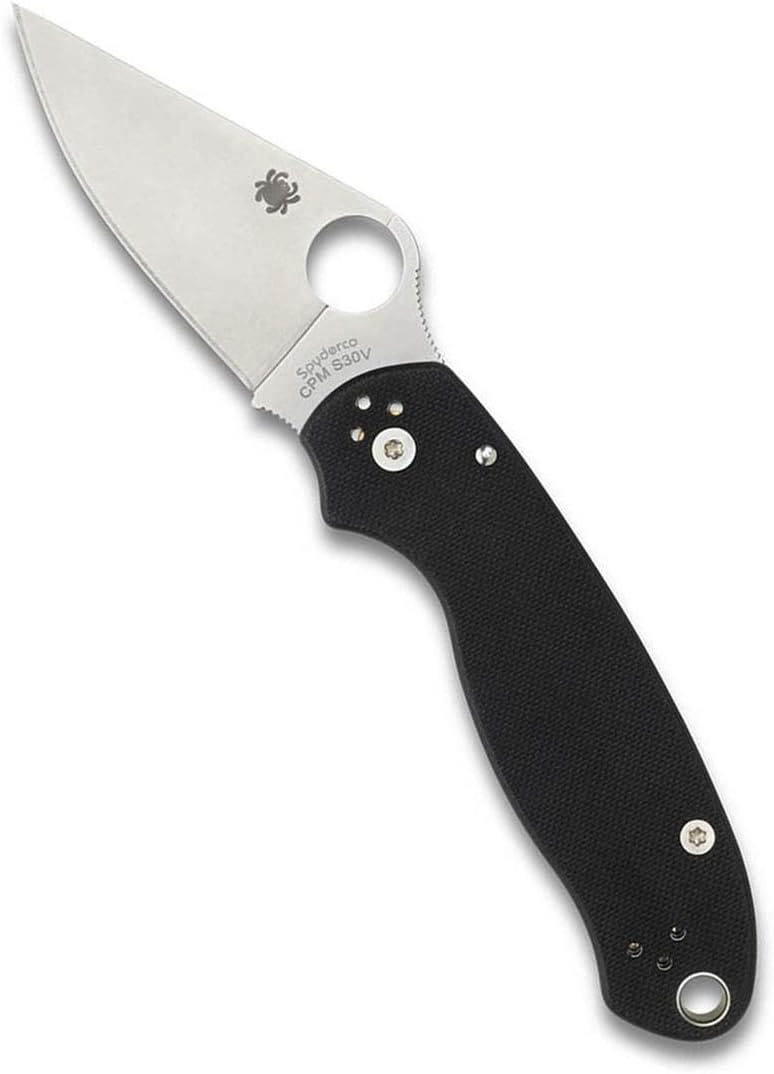
Spyderco upgraded the standard Para 3 from S30V to CPM S45VN a couple of years ago, and it's a meaningful step up. S45VN holds an edge noticeably longer than S30V — we're talking 15–20% more cuts before stropping — and it's slightly tougher at the same hardness. It's also more corrosion-resistant, which matters if you live near saltwater or sweat through your pockets in summer.
The Bugout's CPM-S30V is no slouch. Benchmade runs theirs at 58–60 HRC with their proprietary heat treat, and it takes a wicked edge. It's also easier to sharpen in the field than S45VN — a legitimate advantage if you're touching up on a pocket stone. But objectively, S45VN is the newer, better-balanced powder steel.
Winner: Para 3. S45VN gives you more edge retention and corrosion resistance for the same money.
Ergonomics: G-10 Grip vs Featherweight Comfort
The Para 3's handle is a masterclass in grip design. The G-10 scales have aggressive texture that bites into your hand, the 50/50 finger choil lets you choke up for detail work, and the thumb ramp behind the Spydie hole locks your hand in place. There's a reason people describe it as “an extension of your hand” — even with XL gloves, the Para 3 gives you a full four-finger grip thanks to the choil.
The Bugout takes the opposite approach: thin, light, and unobtrusive. The Grivory scales have enough texture to stay put, but they're smooth enough to slide in and out of a pocket without shredding your jeans. The neutral handle shape accommodates virtually any grip style. The trade-off? At 1.85 ounces, it doesn't feel like you're holding a $200 tool — more like a disposable utility blade that happens to cut forever.
Winner: Tie. Para 3 for hard use and big hands; Bugout for lightweight carry and pocket comfort.
Pocket Clip: Spyderco Wire vs Benchmade Split Arrow
Spyderco uses a deep-carry wire clip on the Para 3 that barely peeks above your pocket seam. It's discreet, it's snag-free, and it doubles as an over-travel stop for the lock bar — clever engineering. The spoon-shaped end makes re-clipping effortless.
Benchmade ships the Bugout with their standard split-arrow clip, which is fine — reversible for tip-up left/right carry — but it's not deep-carry. About 10mm of handle sticks out. If that bothers you, Benchmade sells a deep-carry clip separately for about $10, but that's an extra step.
Winner: Para 3. Deep-carry wire clip out of the box. No modifications needed.
Lock Mechanism: Compression Lock vs AXIS Lock
This is the holy war. The Compression Lock on the Para 3 is arguably the strongest folder lock ever devised — it sandwiches a tab of steel between the blade tang and the stop pin. It's ambidextrous-friendly (mostly), flicks open and shut with a satisfying thwack, and keeps your fingers out of the blade path when closing. The tension is adjustable via the stop pin screw.
The AXIS Lock on the Bugout is the fidget king. Pull the ambidextrous bar back with your thumb and forefinger, and the blade swings freely on phosphor-bronze washers. It's fully ambidextrous, dead simple to operate one-handed, and addictive to play with. The omega springs are the weak point — they can break, though Benchmade will fix them under warranty. In practice, spring failures are rare unless you're treating your knife like a fidget spinner.
Winner: Tie. Compression Lock for pure strength; AXIS Lock for ambidexterity and fidget factor. Both are excellent.
Value: What Does $190–$210 Actually Get You?
At ~$190, the Para 3 gives you: S45VN steel, full stainless liners, peel-ply G-10 scales, a Compression Lock, and a deep-carry wire clip. The fit and finish on Golden, Colorado models is consistently excellent — centered blades, no blade play, factory edges that shave. You're getting a lot of knife for the money.
At ~$180–$210, the Bugout gives you: S30V steel, partial steel liners (just enough for the AXIS mechanism), Grivory scales, an AXIS Lock, and Benchmade's LifeSharp warranty — free sharpening, cleaning, and tune-ups for life. The value proposition is different: you're paying for the engineering of that 1.85-ounce weight and a lifetime service contract.
The Bugout's Grivory scales are the most criticized part of the knife — they flex under hard squeezing and don't scream “$200 knife.” The aftermarket has exploded with titanium, micarta, and carbon fiber replacements, but you shouldn't need to modify a $200 tool. The Para 3's G-10 feels worth the money from day one.
Winner: Para 3. Better materials at a slightly lower price point. The Bugout's LifeSharp warranty is fantastic, but the out-of-box experience favors Spyderco.
Pros & Cons
Spyderco Para 3
- S45VN steel — better edge retention than S30V
- G-10 scales feel premium out of the box
- Compression Lock is insanely strong and fidget-friendly
- Deep-carry wire clip included
- Full steel liners = zero flex
- Massive aftermarket for scales, clips, and hardware
- 50/50 finger choil enables precise detail cutting
Cons
- Heavier — 3.4 oz is noticeable in lightweight shorts
- Wider in pocket due to blade hump and G-10 thickness
- Compression Lock isn't truly ambidextrous (left-handed operation requires practice)
- Spydie hole can be a pocket lint magnet
- Blade-to-handle ratio is mediocre for the overall size
Benchmade Bugout 535
- 1.85 oz — you genuinely forget you're carrying it
- Longer 3.24″ blade in a slimmer package
- AXIS Lock is fully ambidextrous and addictive to fidget
- Benchmade LifeSharp warranty: free sharpening for life
- S30V is easy to touch up in the field
- Huge aftermarket ecosystem for customization
- The best ultralight EDC knife ever made. Period.
Cons
- Grivory scales feel cheap — noticeable flex under hard grip
- Standard clip isn't deep-carry (aftermarket clip costs extra)
- Omega springs are a potential failure point (rare but real)
- More expensive despite lower-grade blade steel
- Partial liners reduce overall rigidity
- S30V is outperformed by Para 3's S45VN
The Verdict: Which One Should You Buy?
There's no single right answer — it depends entirely on your priorities. Here's the breakdown by use case:
Buy the Spyderco Para 3 if…
- You want the best materials for the money. S45VN + G-10 at $190 is hard to beat.
- You use your knife hard — construction, warehouse, camping, and outdoor work.
- You have larger hands and want a full, secure grip.
- You appreciate engineering over marketing. The Compression Lock is a mechanical marvel.
- You want a knife that feels substantial and confidence-inspiring in hand.
Buy the Benchmade Bugout if…
- Weight is your #1 priority. At 1.85 oz, nothing else comes close.
- You carry in lightweight shorts, gym clothes, or suit pants.
- You're left-handed or want true ambidextrous operation.
- You value Benchmade's LifeSharp warranty — free sharpening for life.
- You enjoy customizing and modding your knives. The Bugout aftermarket is unreal.
- You want the fidget-friendliest knife on the market.
FAQ
Is the Bugout worth the price?
This is the most common question in the EDC knife world, and the answer is: it depends on how much you value weight savings.
If you judge a knife purely by materials-per-dollar, the Bugout loses to the Para 3 and several other competitors. S30V and Grivory at $210 is not a screaming deal on paper. But if you judge a knife by how often you actually carry it, the Bugout's 1.85-ounce weight is transformative. A knife that disappears in your pocket gets carried. A knife that's too heavy stays in the drawer. By that metric, the Bugout is absolutely worth it — especially when you factor in Benchmade's lifetime sharpening and warranty service.
The real answer: the Bugout is worth it if you value carry comfort above all else. If you want premium materials at this price point, get the Para 3.
Which is better for big hands?
Hands-down, the Spyderco Para 3. The 50/50 finger choil is the secret weapon here — it transforms what would be a three-finger grip into a rock-solid four-finger hold. Combined with the thumb ramp and aggressive G-10 texture, the Para 3 locks into large hands like it was custom-made.
The Bugout's longer handle gives you a four-finger grip without a choil, which some large-handed users prefer. But the thinness of the handle can feel insecure under heavy pressure — your hand wraps around the Bugout rather than filling the grip. If you wear XL gloves or just want maximum control, the Para 3 wins.
Can I get the Para 3 in S30V instead?
The base G-10 Para 3 now ships with S45VN as standard. You can still find older S30V stock on the secondary market, and the Lightweight version occasionally appears in S30V as well. But honestly — the S45VN upgrade makes the G-10 Para 3 the better buy. Don't hunt down an older version unless you're specifically looking for a sprint run steel like S110V or CruWear.
Which has better aftermarket support?
Both have massive aftermarkets, but the Bugout takes the crown. You can replace literally every component — titanium scales, carbon fiber scales, brass scales, glow-in-the-dark backspacers, anodized thumb studs, custom omega springs, and dozens of clip options. The Bugout is the AR-15 of the knife world: endlessly configurable. The Para 3 has a strong aftermarket too (Flytanium, RGT, Lynch Northwest clips), but the Bugout's ecosystem is simply bigger.
A Third Option: Zero Tolerance 0450
If neither of these two quite fits, the Zero Tolerance 0450 is worth a look. It sits in the same $170-190 price bracket, uses CPM-S35VN steel (a middle ground between the Bugout’s S30V and the Para 3’s S45VN), and pairs a titanium frame lock with a KVT ball-bearing pivot. It’s heavier than the Bugout but noticeably slimmer than the Para 3, and the titanium construction gives it a more premium feel than either competitor at rest. It doesn’t have the Compression Lock’s raw strength or the AXIS Lock’s fidget factor, but it’s a legitimate third option if you want titanium construction in this comparison.
| Knife | Steel | Lock | Price Tier | Best For |
|---|---|---|---|---|
| Spyderco Para 3 | CPM S45VN | Compression Lock | ~$190 | Best materials-per-dollar and hard-use durability |
| Benchmade Bugout | CPM-S30V | AXIS Lock | ~$180-210 | Lightest carry weight and lifetime LifeSharp warranty |
| Zero Tolerance 0450 | CPM-S35VN | Frame Lock (titanium) | ~$170-190 | Buyers who want a titanium-frame midpoint between the other two |
Check Zero Tolerance 0450 on Amazon
Final Thoughts
You can't go wrong with either knife. They represent two different philosophies: the Para 3 is the knife you buy when you want the most knife for your money — premium steel, rock-solid build, and confidence-inspiring ergonomics. The Bugout is the knife you buy when you want the knife you'll actually carry every single day — ultralight, ambidextrous, and backed by a lifetime warranty.
If you forced me to pick one? For 2026, the Spyderco Para 3 edges it out on pure value. S45VN steel at $190 with G-10 scales and a Compression Lock is a package nobody else matches at this price point. But if I'm traveling, hiking, or wearing lightweight shorts all summer — there's a Bugout in my pocket. Sometimes the right answer is both.
Disclosure: Bladeowl is a participant in the Amazon Services LLC Associates Program. As an Amazon Associate, we earn from qualifying purchases at no additional cost to you. This does not affect our recommendations — we only endorse gear we've personally tested and would buy ourselves.