Best Bushcraft Knives for Beginners (2026)
Your first bushcraft knife is the most important one you’ll ever buy. Get it right and it becomes your constant companion—batoning firewood, carving feather sticks, and building shelters. Get it wrong and you’re fighting your tool instead of learning the craft. This guide breaks down what actually matters for beginners: which knives perform, which features are marketing fluff, and where your money is best spent in 2026.
What Makes a Good Bushcraft Knife?
Before we dive into specific models, let’s nail down the three non-negotiables that separate a real bushcraft tool from a decorative sharp object.
Full Tang Construction
A full tang means the blade steel runs the entire length of the handle—one continuous piece of metal from tip to pommel. This is non-negotiable for bushcraft because you’ll be batoning (splitting wood by striking the spine with another piece of wood). A partial or rat-tail tang will fail under that kind of stress. When inspecting a knife, look for exposed steel at the butt of the handle. If the manufacturer hides the tang under plastic or rubber at the pommel, be suspicious. Some excellent knives use a hidden tang done right (like the Morakniv Garberg), but for beginners, visible full tang gives peace of mind.
Scandi Grind
The Scandinavian grind—a single bevel with no secondary micro-bevel—is the gold standard for woodworking knives. It bites into wood with control that hollow grinds and flat grinds simply can’t match. Carving notches, making feather sticks, and planing wood all feel intuitive with a Scandi grind. It’s also the easiest grind to sharpen freehand, which matters enormously when you’re in the field without a guided system.
Carbon Steel (With a Nod to Stainless)
Carbon steel (1095, 80CrV2, UHC) throws better sparks from a ferro rod, takes a keener edge, and is easier to sharpen in th field than most stainless steels. The trade-off? It rusts if you neglect it. A thin coat of mineral oil after use solves that. Stainless options like Sandvik 14C28N have closed the gap significantly—they hold an edge longer in wet conditions and require zero maintenance. We’ll cover this in depth later.
Comparison Table at a Glance
Here’s how the top five beginner bushcraft knives stack up. Everything’s digestible, but if you want the short version: the BPS Adventurer and Morakniv Companion HD are the value kings, and the Garberg is the buy-once-cry-once choice.
| Knife | Steel | Blade Length | Tang | Grind | Price | Rating | Check Price |
|---|---|---|---|---|---|---|---|
| Morakniv Companion HD | Carbon Steel (UHC) | 104 mm / 4.1″ | Partial | Scandi | ~$25 | View | |
| Condor Bushlore | 1075 Carbon | 102 mm / 4.0″ | Full | Scandi | ~$55 | View | |
| BPS Adventurer | 1066 Carbon | 100 mm / 3.9″ | Full | Scandi | ~$35 | View | |
| Morakniv Garberg | Sandvik 14C28N (Stainless) | 109 mm / 4.3″ | Full | Scandi | ~$90 | View | |
| Terävä Jääkäripuukko 110 | 80CrV2 Carbon | 110 mm / 4.3″ | Full | Scandi | ~$60 | View |
In-Depth Reviews
1. Morakniv Companion HD — Best Budget Starter
The Companion HD is the knife that launched a thousand outdoor careers. At ~$25, it delivers a 104mm carbon steel blade with a ruthlessly sharp Scandi grind right out of the box. The HD variant uses a thicker 3.2mm blade stock (vs. the standard Companion’s 2.5mm), making it capable of light batoning. The rubberized handle is grippy in wet conditions and surprisingly comfortable during extended carving sessions.
The Catch: It’s a partial tang—a rat-tail tang embedded in the plastic handle. For carving and light tasks this is absolutely fine. For heavy batoning through knotty oak? You’ll want something beefier. The sheath is also basic injection-molded plastic—functional but uninspiring.
- Pros: Unbeatable value, hair-popping sharp out of the box, carbon steel sparks ferro rods beautifully, grippy wet-weather handle, lightweight (135g)
- Cons: Partial tang limits heavy batoning, basic plastic sheath, carbon steel requires drying after use, handle not replaceable
2. Condor Bushlore — Classic Woodcraft Soul
Made in El Salvador, the Condor Bushlore is a full-tang 1075 carbon steel workhorse with a walnut handle that actually looks like something your grandfather would have used. The 4-inch blade is ground in a true zero Scandi—meaning the primary bevel goes all the way to the edge with no micro-bevel. This makes it an exceptional carver. At ~$55 it sits in a sweet spot: full tang confidence without the premium price tag.
The Catch: Condor’s quality control is inconsistent. You might get a perfectly centered grind, or one that needs 20 minutes on a stone. The leather sheath is handsome but holds moisture against the blade—swap it or treat it with beeswax. The 1075 steel is tough but needs frequent stropping to stay shaving-sharp. Also worth noting: availability fluctuates on Amazon, so it may not always be in stock at the listed price.
- Pros: Full tang, beautiful walnut handle, pure Scandi grind for carving, punches above its price class, classic aesthetic
- Cons: Inconsistent factory edge, leather sheath needs treatment, 1075 edge retention is moderate, availability can be spotty
3. BPS Adventurer — The Underdog from Ukraine
BPS Knives out of Ukraine has quietly become a force in the budget bushcraft world. The Adventurer is a full-tang 1066 carbon steel blade with a walnut handle, leather sheath, and Scandi grind—all for around $35. That spec sheet at that price is almost absurd. The blade stock is 3.4mm thick, giving it enough spine for confident batoning. The fit and finish won’t match a $200 knife, but the fundamentals are all there. If you’re on a tight budget and want a true full-tang bushcraft knife, this is the answer.
The Catch: 1066 carbon is softer than 1095 or 80CrV2. It’ll roll or dull faster under heavy use—but it sharpens back up in seconds. The sheath is genuine leather but basic; the fit can be loose. Some units ship with a slight patina already forming, which is cosmetic only.
- Pros: Insane value, full tang + Scandi + leather sheath for $35, 3.4mm thick blade good for batoning, walnut scales feel premium, easy to sharpen
- Cons: 1066 steel needs more frequent sharpening, sheath fit can be loose, occasional cosmetic imperfections, softer spine for ferro-rod striking (you may need to file a sharp 90° section)
4. Morakniv Garberg — The Premium Workhorse
The Garberg is Mora’s answer to the question: “What if we made a Companion that could survive a nuclear winter?” It’s full tang, 3.2mm Sandvik 14C28N stainless steel, and built with a Scandi grind that’s sharp enough to shave with. At ~$90 it’s the most expensive knife on this list—and it earns every dollar. The 14C28N steel holds an edge dramatically longer than carbon steels while being completely rust-proof. If you camp in wet environments or near salt water, this is your knife.
The Catch: The polyamide handle, while indestructible, is polarizing. Some love the grip; others find it hard and unyielding during long carving sessions. The spine comes with a sharp 90° edge from the factory for ferro rods—a thoughtful touch. There’s also a carbon steel version available if you prefer that route, though the stainless variant is generally better for all-weather users. The multi-mount sheath system is clever but over-engineered for most people.
- Pros: Full tang, zero-maintenance stainless, razor-sharp factory edge, 90° spine for ferro rods, multi-mount sheath, buy-it-for-life durability
- Cons: Premium price, polyamide handle is hard on hands during long sessions, stainless doesn’t throw sparks quite as well as carbon, slightly heavy at 230g
5. Terävä Jääkäripuukko 110 — The Finnish Beast
“Jääkäripuukko” means “Jaeger puukko”—a fighter’s knife from Finland. Varusteleka’s house-brand Terävä lives up to that name. The 110mm blade is 80CrV2 carbon steel at 4.2mm thick, making it the burliest knife on this list. This is a knife you can baton through seasoned hardwood without flinching. The textured rubber handle is the best in its class: comfortable, secure in rain and snow, and shaped for multiple grips. At ~$60 it’s a steal for what you get—Finnish design, Austrian steel, and battle-tested durability.
The Catch: It’s primarily sold through Varusteleka.com, not always readily available on Amazon—though you can often find them listed by third-party sellers. At 175g it’s hefty for a puukko-style knife. The edge ships with a slight convex on top of the Scandi, which purists might want to re-grind. The 80CrV2 steel is tough as nails but needs the same rust maintenance as any carbon steel. The included leather dangler sheath is excellent and well-designed.
- Pros: Indestructible 4.2mm 80CrV2 blade, best-in-class handle grip, batoning monster, included leather dangler sheath, outstanding value at $60
- Cons: Limited Amazon availability (primarily sold via Varusteleka), heavier than competitors at 175g, slight convex edge from factory may bother Scandi purists, carbon steel maintenance required
Scandi vs Flat vs Convex Grind: What’s the Difference?
The grind is how the blade tapers from the spine to the cutting edge—and for bushcraft, it matters more than the steel type.
Scandi Grind: A single flat bevel with no secondary angle. Think of it as a V-shape from the edge to roughly one-third up the blade. This grind excels at woodworking—carving, planing, and making controlled cuts. It’s also the easiest grind to sharpen freehand because the entire bevel flat against the stone is your angle guide. The downside: it’s not as durable as a convex edge for heavy chopping, and it can wedge in deep cuts.
Flat Grind: Tapers consistently from a point higher on the blade (or all the way from the spine) down to the edge, often with a secondary micro-bevel. Common on chef’s knives and many EDC folders. It’s a great all-rounder for slicing but lacks the wood-biting control of a Scandi for bushcraft tasks. A flat grind with a fine secondary bevel can get squirrelly when carving.
Convex Grind: Curves outward like an axe edge—no distinct bevel angle. This is the strongest edge geometry for chopping and heavy-duty use because the steel behind the edge is thick. Battle axes, survival knives, and many Bark River models use convex grinds. The trade-off: it’s harder to sharpen without practice (you need to “roll” the blade on the stone) and it doesn’t bite into wood as cleanly as a Scandi for fine carving.
Verdict for Beginners: Scandi. It’s the most forgiving to sharpen, the best for learning woodcraft, and every knife on this list except the Terävä (which ships with a very slight convex on the Scandi) uses it. Once you’ve mastered the Scandi, experimenting with convex edges on your second knife makes sense.
Carbon vs Stainless Steel for Bushcraft
This debate generates more forum drama than it deserves. Both work. Here’s the honest breakdown.
| Factor | Carbon Steel | Stainless Steel |
|---|---|---|
| Edge Retention | Good to excellent (depends on alloy) | Good to excellent (14C28N, CPM-Magnacut) |
| Sharpening Ease | Easier—stone bites faster | Harder—abrasion resistance works both ways |
| Ferro Rod Sparks | Excellent—throws big, hot sparks | Decent—works but less aggressive |
| Rust Resistance | None—needs oil and drying | Excellent—near immune |
| Patina | Develops character (some love this) | Stays clean (some find this sterile) |
| Cost | Generally lower | Generally higher (but shrinking) |
My take: For beginners, start with carbon steel. It forces good habits—you have to wipe your knife dry, you have to oil it occasionally. Those habits build knife respect. Plus it’s cheaper and easier to learn sharpening on. If you live in a perpetually wet environment (Pacific Northwest, UK, tropics) or do extended trips where maintenance is impractical, go stainless. The Garberg in 14C28N is arguably the best all-conditions bushcraft knife on the market today. For everyone else, the Companion HD or BPS Adventurer in carbon is the smarter starting point.
Beginner Bushcraft Tips: Three Skills to Master First
A great knife is useless without technique. Here are the three foundational skills every bushcraft beginner should practice—and the safety rules that keep you out of the ER.
Batoning: Splitting Wood Without an Axe
Batoning is using a wooden “baton” (a sturdy stick) struck against the knife’s spine to drive it through wood, splitting it lengthwise. This is the single most important bushcraft technique because it lets you process firewood with just a knife. Key rules: use only straight-grained, knot-free wood (birch and pine are ideal). Hold the knife by the handle—not the blade—and strike the exposed spine near the tip to start the split, then work your way back. Never baton through a knot: the knife will bind, and prying it out can snap the tip or twist the blade. If the knife stops mid-split, don’t twist it. Tap it back out in reverse. A full-tang knife handles this with confidence; a partial tang knife like the Companion HD should only be used for light batoning on wrist-thick pieces.
Feather Sticks: Your Fire-Starting Best Friend
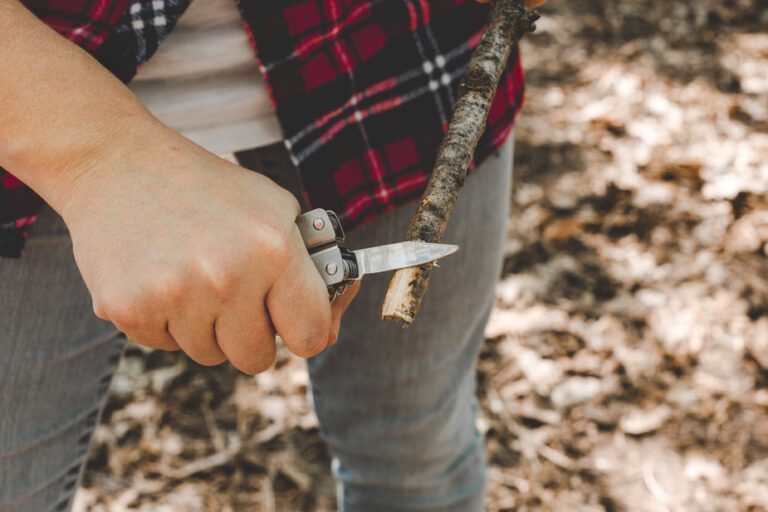
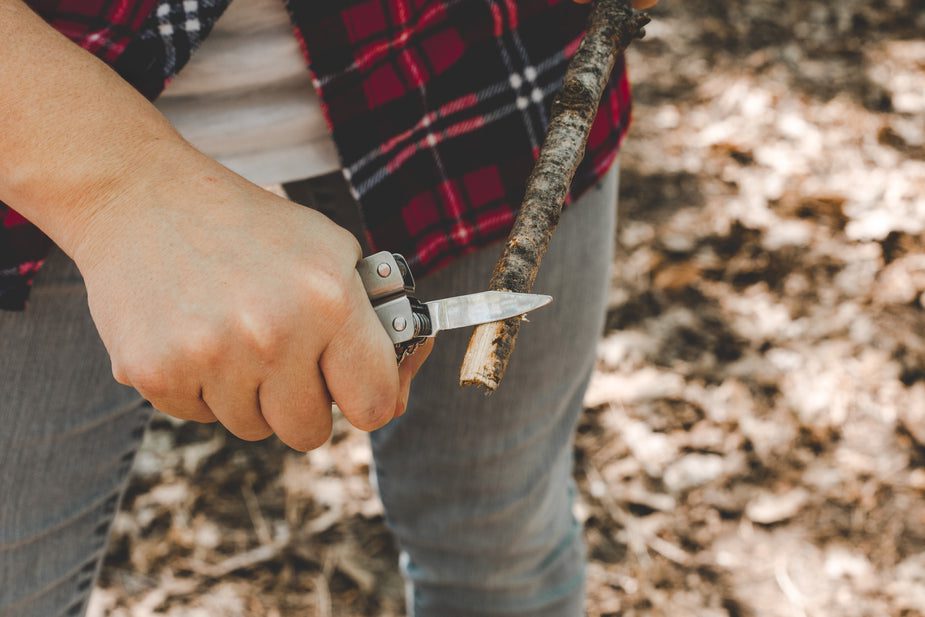
A feather stick is a piece of wood shaved into thin curls that catch a spark almost instantly. The technique: find a dry, straight-grained stick (thumb thickness). Hold the knife at about a 20° angle and push it along the grain with steady pressure. Don’t saw—one smooth push per curl. The curls should be thin enoughto see light through but still attached to the stick at the base. A Scandi grind makes this almost effortless because the broad bevel naturally rides along the wood and prevents the knife from digging too deep. Practice on dry cedar, pine, or birch—they feather beautifully. Wet wood won’t feather well; split it open and use the dry interior. A well-made feather stick can take a spark from a ferro rod on the first strike.
Safety Rules That Save Fingers
- Always cut away from your body. The “triangle of death”—femoral arteries in both thighs and the inside of your off-arm—is real. Never brace wood against your leg while cutting toward yourself. That’s the #1 cause of bushcraft knife injuries.
- Keep your off-hand behind the blade. When carving, your support hand should always be behind the cutting edge’s path. If the knife slips, it hits air, not flesh.
- A sharp knife is safer than a dull one. Dull blades require more force, which means less control. Learn to strop (leather + compound) and touch up your edge before it goes dull—stopping every 20-30 minutes of carving keeps the edge razor-sharp and predictable.
- Sheath discipline. When not actively cutting, the knife goes in the sheath. No exceptions. Not on your lap, not stuck in a log, not “just for a second.” Build the muscle memory: cut, sheath, repeat.
- Carry a first aid kit with a trauma dressing. Israeli bandages and a tourniquet weigh almost nothing. If you’re using sharp tools in the woods, you carry them. Period.
The Bottom Line: Which One Should You Buy?
If I had to pick winners for different scenarios:
- Absolute Beginner, Tight Budget: Morakniv Companion HD — $25, scary sharp, teaches good carbon steel discipline.
- Best Value with Full Tang: BPS Adventurer — $35 for a full tang Scandi with leather sheath. Unmatched at this price.
- Buy Once, Cry Once: Morakniv Garberg Stainless — $90, zero rust worry, lifetime durability, premium build quality.
- The Overbuilt Tank: Terävä Jääkäripuukko 110 — $60, batons through anything, best handle grip in the game.
- Traditionalist’s Choice: Condor Bushlore — $55, walnut and 1075 carbon. Old-school soul in a modern budget.
All five knives will serve you well. The Companion HD and BPS Adventurer are gateways—you’ll learn what you like, what you don’t, and whether you want to invest in something more expensive later. The Garberg and Jääkäripuukko are keepers that’ll still be in your pack a decade from now.
My personal recommendation for 2026: Get the BPS Adventurer as your practice knife, master the basics, and when you’re ready, upgrade to the Garberg Stainless. The Adventurer becomes your backup/glovebox knife—and at $35, that’s a steal.
Frequently Asked Questions
A: For carving and light camp tasks, no—millions of Mora Companions have proven that. But the moment you start batoning (and you will), full tang becomes important. It’s not about snobbery—it’s about your knife not snapping in half when you’re miles from the trailhead. For $35, the BPS Adventurer removes that worry entirely.
A: 90–110mm (3.5–4.3 inches). Shorter and you lose batoning capability; longer and you lose carving precision. All the knives on this list fall in that sweet spot. The Jääkäripuukko at 110mm is the upper bound—anything bigger is a camp knife, not a bushcraft knife.
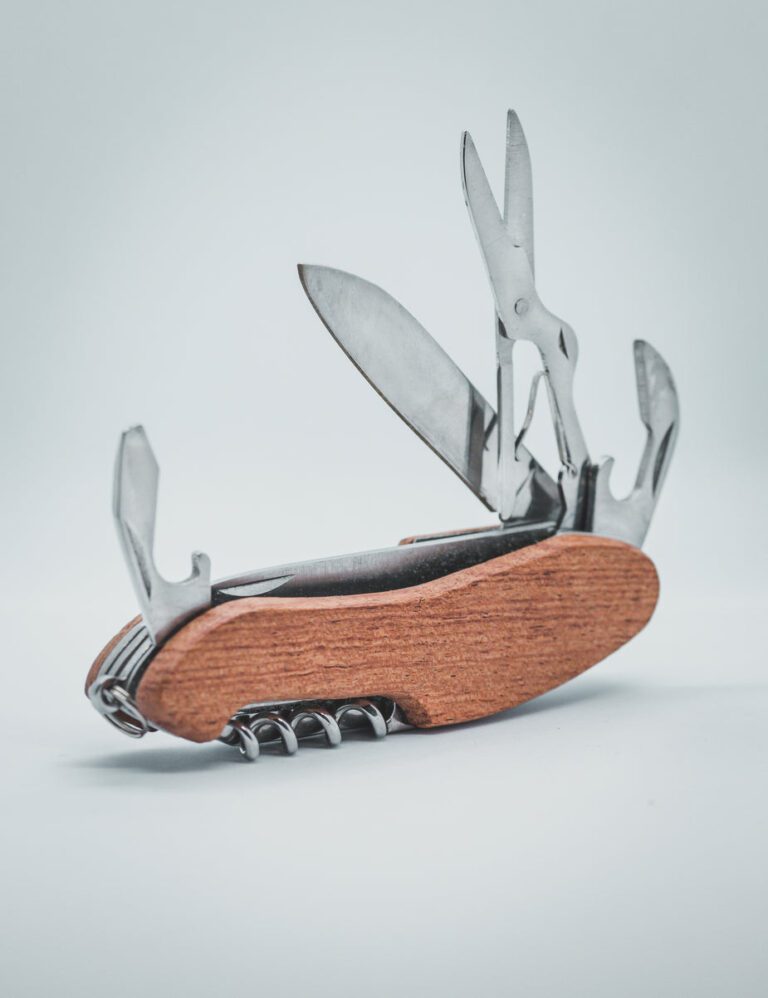
A: You can, but you shouldn’t. A folding knife’s pivot is a failure point under lateral stress. Batoning with a folder will destroy it—and possibly your hand when the lock fails. Fixed blade, always.
A: Three things: dry it after use (every time), apply a thin coat of mineral oil (food-safe), and don’t store it in a leather sheath long-term (leather traps moisture). That’s it. Takes 30 seconds. Skip this and you’ll get rust spots—cosmetic at first, pitting eventually. A forced patina (mustard or vinegar) adds a protective layer if you’re lazy about oiling.
Ready to Start Your Bushcraft Journey?
The right knife makes the difference between frustration and flow in the woods. Every knife on this list has been field-tested and proven by thousands of bushcrafters. Pick the one that fits your budget and environment, and start practicing those three core skills.
Click any button above to check current prices on Amazon. As an Amazon Associate, I earn from qualifying purchases at no extra cost to you—this helps keep bladeowl.com running and independent.
Got questions about a specific knife? Drop a comment below or hit me up—I read every one. Happy carving, and keep your blade sharp.
— The Bladeowl Team
Disclosure: bladeowl.com is a participant in the Amazon Services LLC Associates Program, an affiliate advertising program designed to provide a means for sites to earn advertising fees by advertising and linking to Amazon.com. As an Amazon Associate we earn from qualifying purchases.