How to Spot Fake and Counterfeit Knives on Amazon and eBay
You found a $250 Benchmade Bugout for $89 on Amazon. Or a Spyderco Para 3 for $65 on eBay. The listing photos look legit, the seller has decent feedback, and the deal seems too good to pass up. But there’s a reason it’s so cheap — and that reason is China’s sprawling counterfeit knife industry. Counterfeit knives have become so sophisticated that even experienced collectors can get fooled. Here are the seven warning signs that separate legitimate blades from dangerous fakes.
The Scale of the Problem
The counterfeit knife problem has exploded in the past five years. Chinese factories that once produced generic knockoffs now manufacture “clone” knives using CNC machining, laser etching, and packaging that mimics authentic products down to the UPC code. Brands like Benchmade, Spyderco, Microtech, Chris Reeve, and Zero Tolerance are the most commonly counterfeited. The fakes have gotten so good that dedicated YouTube channels and Reddit communities (r/KnifeCheck, r/chineseknives) exist solely to help buyers authenticate their purchases.
Why does it matter? Counterfeit knives use mystery steel — often low-grade stainless that won’t hold an edge, may contain lead or other toxins, and can fail catastrophically under stress. They also undermine the intellectual property of the American, European, and Japanese companies that invest millions in R&D. And they’re illegal to sell or import under federal law.
7 Warning Signs You’re Looking at a Fake
1. The Price Is Too Good to Be True
This is the number one red flag. Legitimate knife retailers operate on thin margins — typically 20-30% below MSRP is the deepest discount you’ll ever see from an authorized dealer. If a $200 knife is selling for $60, it’s a fake. Period. Counterfeiters exploit the psychology of the “steal deal” — they know buyers want to believe they’ve found a secret bargain. Don’t be that buyer.
Red flag threshold: Any discount deeper than 40% below MAP (Minimum Advertised Price) on a current-production model.
2. The Fonts and Logos Are “Off”
Counterfeiters struggle most with typography. Study the authentic logo of the brand you’re buying — the exact font weight, letter spacing, and sizing. Compare the laser etching on the blade to photos from the manufacturer’s website. Common tells include:
- Letters that are too thick or too thin compared to authentic
- Uneven spacing between letters
- The registered trademark (®) symbol being the wrong size or positioned incorrectly
- Steel marking fonts that don’t match the manufacturer’s current style
- Logo elements that are slightly distorted or pixelated (indicates a scanned logo, not the original vector art)
Spyderco’s round hole logo and Benchmade’s butterfly are two of the most commonly counterfeited marks. Study authentic examples carefully before buying.
3. The Box and Packaging Don’t Match
Legitimate knife manufacturers invest heavily in packaging. Counterfeiters cut corners — sometimes literally. Warning signs in packaging include:
- Flimsy or incorrect box material (Benchmade uses high-quality matte black boxes; fakes often use cheaper glossy cardboard)
- Missing or incorrect foam inserts
- Spelling errors on labels or documentation
- Missing warranty cards or registration information
- Barcode/UPC that doesn’t scan to the correct product
- Plastic bags with incorrect printing or thickness
Some manufacturers have started including QR codes or holographic authentication stickers. Benchmade includes a unique product registration card. If these are missing, proceed with extreme caution.
4. The Hardware and Fasteners Are Wrong
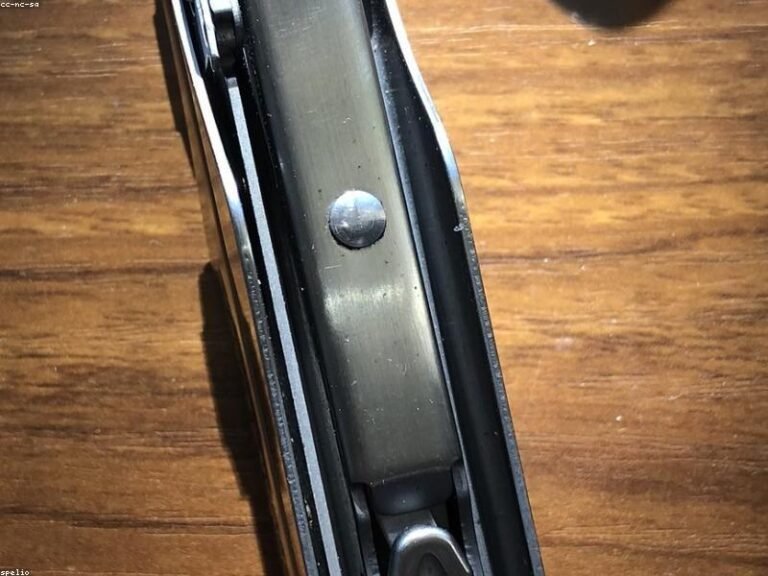
This is one of the easiest tells once you know what to look for. American and Japanese manufacturers use specific hardware standards — typically Torx screws in T6, T8, or T10 sizes. Counterfeit knives often use:
- Phillips or flathead screws instead of Torx
- Wrong Torx sizes (a T6 where an authentic knife uses T8)
- Screws that sit proud (above the surface) instead of being flush or recessed
- Different screw head profiles (domed instead of flat)
- Pivot screws with the wrong number of engagement slots
For clip screws especially, the counterfeits almost always get this wrong. Compare close-up photos of the screws to known authentic examples.
5. The Steel Markings Don’t Add Up
Premium knife steels like CPM-S30V, M390, CPM-MagnaCut, and CPM-CruWear are expensive to source and machine — that’s why counterfeits use cheap alternatives. Fortunately, the counterfeiters often make mistakes in the markings. Watch for:
- Steel designations that don’t match the model (a “S30V” marking on a model that’s only produced in M390)
- Missing the “CPM-” prefix on particle metallurgy steels
- Wrong steel markings on limited editions or sprint runs
- Steel stamps located in the wrong position on the blade
If you’re unsure, check the manufacturer’s website for the current steel specifications of that model. Counterfeiters often copy markings from older versions or entirely different models.
6. The Action and Build Quality Are Subpar
This is harder to assess from photos, but once you have the knife in hand, the differences become obvious. Authentic premium knives have:
- Smooth, consistent pivot action without blade play
- Even grinds that are perfectly symmetrical
- Clean, chamfered edges on handle scales (no sharp corners)
- Proper lock engagement (frame locks should engage at 25-50% of the lock face; liner locks should click firmly into place)
- Consistent finishes without tool marks, swirls, or uneven coating
Fakes often have gritty action, uneven blade grinds, lock rock (the blade moves when locked), and sharp edges on the handle where they should be rounded. The weight may also be off — counterfeiters can rarely match the exact density of G10, titanium, or carbon fiber.
7. The Seller Is Not an Authorized Dealer
The single best protection against counterfeits is buying from authorized dealers. Every major knife brand maintains a list of authorized retailers on their website. If the seller isn’t on that list — especially on Amazon or eBay — you’re rolling the dice. Some specific tips:
- Amazon: Look for “Ships from and sold by Amazon.com” or a brand’s official Amazon store (Benchmade, Victorinox, and others have official stores). Third-party sellers with names like “KNIFEGUY88” or generic Chinese storefront names are high-risk.
- eBay: Check the seller’s location. If it says “Ships from China” or “Ships from Hong Kong” for an American-made knife brand, it’s almost certainly counterfeit.
- AliExpress/DHGate/Wish: Just don’t. Anything claiming to be a Benchmade, Spyderco, or Chris Reeve on these platforms is fake.
How to Buy Authentic Knives Safely
The safest approach is buying directly from authorized dealers. Here are reliable options for the brands most commonly counterfeited:
- Benchmade: Buy from Benchmade’s official Amazon store or authorized dealers like Blade HQ, KnifeCenter, and GP Knives. Benchmade Bugout on Amazon
- Spyderco: Spyderco has an official Amazon presence and a comprehensive dealer network. Spyderco Dragonfly 2 on Amazon
- Zero Tolerance / Kershaw: Both Kai USA brands are sold through authorized Amazon listings. ZT 0350 on Amazon
- Victorinox: Victorinox has an extensive official Amazon store. Victorinox Classic SD on Amazon
What to Do If You Bought a Fake
If you suspect you’ve purchased a counterfeit knife:
- Document everything: Take clear photos of the knife, packaging, and listing.
- Contact the platform: Amazon and eBay have counterfeit reporting systems. Amazon’s “Report a Violation” tool is the fastest path.
- Request a refund: Both platforms have money-back guarantees for counterfeit goods.
- Alert the manufacturer: Most knife companies have dedicated email addresses for reporting counterfeits. They can confirm whether your knife is authentic and may use your information to pursue legal action against counterfeiters.
The bottom line: if a deal seems too good to be true, it is. Premium knives hold their value specifically because they’re made from expensive materials with precision manufacturing. There are no secret $40 Benchmades — only convincing counterfeits waiting to take your money. Buy from authorized dealers, compare against reference photos, and trust your instincts. A knife that arrives with even one of these warning signs is probably not the premium blade you paid for.
This article may contain affiliate links. If you purchase a product through one of these links, Bladeowl may earn a commission at no extra cost to you. This never influences our editorial independence or which products we recommend.