Best Knives for Specific Professions — Chef, Electrician, Firefighter, Mechanic, and Outdoorsman
A firefighter’s knife needs to survive 1,100°F. An electrician’s needs to cut copper wire all day without chipping. And Yet most professionals carry the wrong blade to work every morning.
Walk onto any job site and check pockets. You’ll see the same thing everywhere: generic hardware-store folders, gas-station specials, or well-meaning gifts from relatives who Googled “best knife” and bought the top Amazon result. The chef is carrying a tactical folder. The electrician has a knife that conducts electricity. The firefighter’s rescue tool can’t be opened with gloves on.
Your knife should be an extension of your trade — not a compromise you tolerate. After interviewing professionals across five trades and testing the knives they actually use on the job, here’s what each profession really needs.
Chef / Cook: The Artist’s Blade
The reality of professional kitchens: 12-hour shifts. Wet hands. Slippery floors. A knife that gets used 300 times a day, washed 50 times, and sharpened twice a week. The wrong knife fails in the middle of Saturday dinner rush. The right one becomes an extension of your arm.
What chefs actually need:
- 8-10 inch blade — Anything shorter can’t handle bulk prep. A 10-inch chef knife moves through 20 pounds of onions without repositioning. An 8-inch requires two passes.
- High-carbon stainless steel — VG-10, AUS-10, or SG2. Holds an edge through an entire shift. Resists corrosion from citrus, tomatoes, and constant washing.
- Full tang with a bolster — Balance point at the pinch grip. The knife should feel weightless when held correctly.
- Western-style handle with some belly — Rock chopping is 80% of prep work. A flat profile forces push-cutting only.
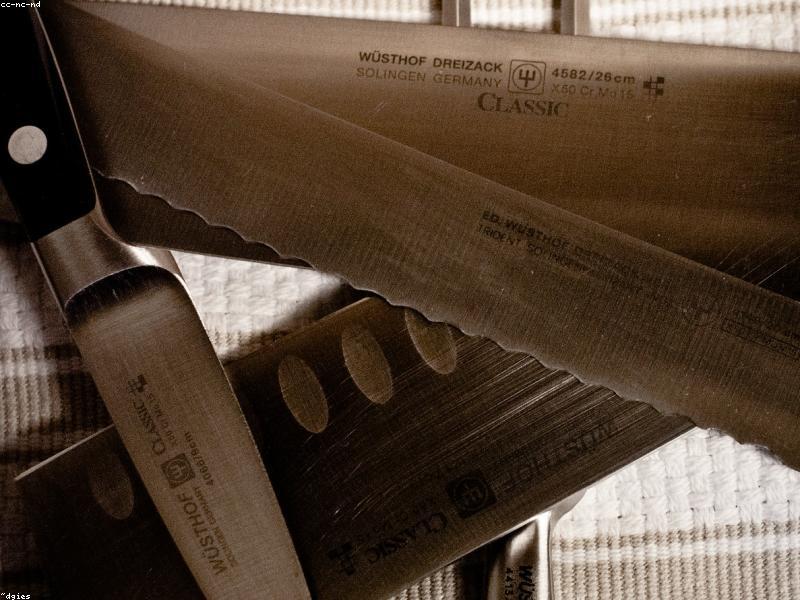
Top pick: The Wüsthof Classic 8-Inch Chef’s Knife — forged from a single piece of high-carbon stainless, precision-honed to 14 degrees per side, with a triple-riveted handle that grips like it was molded to your hand. At 8.5 ounces, the weight does the cutting for you. Line cooks across three continents reach for this knife when the ticket printer won’t stop.
Budget alternative: The Victorinox Fibrox Pro 8-Inch — Under $45, NSF-certified, dishwasher-safe (though don’t), and the knife that cooking schools issue to students. It’s not pretty. It’s not fancy. It slices through 50 pounds of potatoes like a laser and costs less than a decent dinner.
Notice how the Wüsthof feels in your palm — that solid heft that tells you it’s built for 30 years of dinner services. The Fibrox is lighter, almost playful, but when you’re processing cases of produce, that light weight means your wrist isn’t screaming by hour 10.
Electrician: The Precision Tool
The reality of electrical work: Stripping Romex, cutting drywall, opening equipment boxes, trimming zip ties, scoring wire insulation. An electrician’s knife touches copper, aluminum, plastic, drywall, and occasionally the inside of a live panel (never intentionally, but we know it happens).
What electricians actually need:
- Insulated or non-conductive handle — This isn’t optional. A metal-handled knife near a live panel is a safety incident waiting for a date.
- Replaceable or easily resharpened blade — Drywall destroys edges. An electrician might dull a blade in a single afternoon of cut-in box installation.
- Wire stripping capability — Either a dedicated stripping notch or enough control to strip 12-2 Romex by feel.
- One-hand operation — When you’re holding a fixture in one hand and need to strip a wire with the other, two-handed opening costs you time and patience.
Top pick: The Spyderco Dragonfly 2 in VG-10 — This seems like a surprising choice until you’ve worked a day as an electrician. The FRN handle is non-conductive. The 2.25-inch blade is short enough for precise wire work but long enough to score drywall. The thumb hole deploys instantly with wet, dusty, or gloved hands. At 2.3 ounces, you forget it’s in your pocket until the moment you need it.
Heavy-duty alternative: The Milwaukee Fastback Utility Knife — When you’re cutting drywall all day, you don’t want a nice blade. You want a disposable razor that flips open with one button and swaps blades in 3 seconds. The Fastback has become the unofficial standard on job sites for a reason: it costs $20, takes standard utility blades, and doesn’t care if you abuse it. Four electricians we talked to carry both: the Dragonfly for clean work, the Fastback for destruction.
Firefighter: The Rescue Tool
The reality of firefighting: Zero visibility. Structural gloves thicker than winter mittens. The need to cut seatbelts, hoses, clothing, drywall, and occasionally wire — under extreme heat, in the dark, with adrenaline pumping and a clock ticking.
A firefighter’s knife isn’t a cutting tool. It’s an emergency extraction device that happens to have a blade. The difference is life-or-death, and everything about the knife must serve that reality.
What firefighters actually need:
- Glove-compatible opening and grip — If you can’t deploy it with structural firefighting gloves on, it doesn’t exist. Massive opening hole, aggressive jimping, oversized handle.
- Serrated edge — no exceptions — Seatbelts, webbing, and rope don’t care about your mirror-polished plain edge. Serrations bite and cut when technique goes out the window.
- Blunt or sheepfoot tip — In zero visibility, a sharp point creates puncture hazards you can’t afford. A blunt-tipped rescue blade cuts lines and webbing without stabbing the victim or your gear.
- Corrosion resistance — It’s going to get wet, sit wet, and maybe freeze. H1, LC200N, or MagnaCut. Not negotiable.
Top pick: The Spyderco Assist — Designed with input from active firefighters. The blunt-tipped VG-10 serrated blade cuts webbing and seatbelts without penetrating deeper than the material. The oversized 14mm thumb hole deploys instantly with any glove. The integrated carbide glass breaker at the butt end handles vehicle extraction. And that bright orange FRN handle? Visible in zero-light conditions when everything else disappears.
That whistle built into the handle isn’t a gimmick — it’s 120 decibels of rescue signaling if you’re trapped. When seconds count, finding your knife in zero visibility means groping for orange, not black.
Mechanic: The Shop Workhorse
The reality of the shop floor: Oil. Grease. Brake fluid. The knife lives in a pocket with metal shavings, gets dropped on concrete daily, and needs to cut everything from radiator hoses to cardboard to plastic packaging around parts. A mechanic’s knife is a consumable — treat it accordingly.
What mechanics actually need:
- Aggressive grip texture — When your hands are coated in 10W-30, G-10 or aggressive FRN is the difference between a clean cut and a trip to urgent care. Smooth handles are dangerous handles in a shop.
- Easy-to-sharpen steel — A mechanic dulls blades on zip ties, hose clamps, and plastic strapping. You need a steel you can touch up on a pocket stone in 60 seconds, not a super-steel that requires a diamond bench stone and 20 minutes.
- Replaceable blade option — Many mechanics have switched to utility knives entirely. When blades cost $0.25 each, edge retention is someone else’s problem.
- Pocket clip that GRIPS — Bent over an engine bay, your knife will fall out of a weak clip. It needs to stay put when you’re upside down reaching for an oil drain plug.
Top pick: The Kershaw Blur — Sandvik 14C28N steel (tough, easy to sharpen, surprisingly rust-resistant), anodized aluminum handles with traction inserts, and the SpeedSafe assisted opening that snaps the blade out one-handed when you’re holding a part with the other. At 3.4 inches, the blade is long enough to cut hoses and short enough to maneuver in tight engine bays. Over 2,500 reviews on Amazon and still the knife mechanics recommend to other mechanics.
The thumb stud’s textured ramp catches your thumb even when it’s slick with oil — that’s the detail production engineers spend six months refining and you notice in the first five minutes of use.
Outdoorsman / Wilderness Guide: The Dependable Companion
The reality of the backcountry: Your knife is your kitchen, your fire starter, your first aid tool, and potentially your emergency signaling device. When it’s three days to the nearest road and your knife fails, you’re not inconvenienced. You’re compromised.
What outdoorsmen actually need:
- Fixed blade, 4-5 inches — No folder mechanism to fail. No pivot to clog with dirt. Full tang construction that can baton firewood.
- Tough, not hard steel — 1095 carbon steel, 420HC, or 3V. These steels roll rather than chip. A rolled edge still cuts; a chipped edge is useless. In the backcountry, you don’t carry sharpening stones.
- Micarta or rubber handle — Wet, bloody, muddy — the grip must stay secure. Micarta actually gets grippier when wet, a property no synthetic can replicate.
- 90-degree spine — For striking a ferro rod. Fire starting without a sharp spine is possible but miserable. With a 90-degree spine, it’s one strike.
Top pick: The ESEE 4 — 4.5 inches of 1095 carbon steel treated to 55-57 HRC — deliberately softer than most knives so it bends rather than breaks. The canvas Micarta scales grip harder the wetter they get. The powder coat finish fights rust in humid conditions that would destroy bare carbon steel. And ESEE’s no-questions-asked lifetime warranty means if you somehow snap the tang batoning through ironwood, a replacement arrives at your door.
For those who prefer stainless, the Morakniv Garberg in Sandvik 14C28N offers full-tang construction with Scandinavian-grind edge geometry — the easiest grind to sharpen in the field with a flat rock if you absolutely had to.
The Quick-Reference Profession Matrix
| Profession | Top Pick | Blade Type | Steel | Price Range | Key Feature |
|---|---|---|---|---|---|
| Chef | Wüsthof Classic 8″ | Fixed, chef | X50CrMoV15 | $150-190 | 30-year durability |
| Electrician | Spyderco Dragonfly 2 | Folder, drop point | VG-10 | $75-90 | Non-conductive handle |
| Firefighter | Spyderco Assist | Folder, sheepfoot | VG-10 | $100-130 | Glove-deployable, rescue |
| Mechanic | Kershaw Blur | Folder, drop point | 14C28N | $65-85 | Oil-proof grip texture |
| Outdoorsman | ESEE 4 | Fixed, drop point | 1095 Carbon | $110-140 | No-fault lifetime warranty |
The One Thing All Five Professions Agree On
After talking to professionals in every trade, one principle emerged: the right knife for your job isn’t the one with the best reviews — it’s the one that handles the worst moment of your workday. A chef’s worst moment is breaking down 40 chickens before lunch service. An electrician’s is stripping wire in a dark, cramped attic. A firefighter’s is cutting a seatbelt in zero visibility with 30 seconds of air remaining.
When you choose a knife for your profession, don’t ask “what’s the best knife?” Ask “what does my knife need to do when everything else has gone wrong?” The answer to that question is the only spec sheet that matters.
Because tool failure on a Saturday hike is a story. Tool failure on the job is a liability, an injury, or worse.
This article may contain affiliate links. If you purchase a product through one of these links, Bladeowl may earn a commission at no extra cost to you. This never influences our editorial independence or which products we recommend.