Kitchen Knife Storage Guide — Magnetic Strips vs Blocks vs Drawer Inserts (What Actually Protects Your Edge)
Why Knife Storage Deserves More Attention Than It Gets
Most home cooks spend a lot of time researching which knives to buy and almost no time thinking about how to store them. Then they toss $200 worth of sharp steel into a cluttered kitchen drawer where the blades bounce against each other every time someone opens it. The result: dull edges, chipped tips, and knives that need sharpening three times as often as they should.
Good knife storage does three things: it protects the edges from damage, it keeps the knives accessible during cooking, and it keeps everyone in the kitchen safe from accidentally grabbing a sharp blade. The right storage solution depends on your kitchen layout, how many knives you own, and whether you prioritize aesthetics, accessibility, or space efficiency. We’ve tested all the major options, and here’s our comprehensive guide to keeping your knives sharp and your fingers intact.
Magnetic Knife Strips
The Verdict: Best overall for most kitchens.
A magnetic knife strip is a wall-mounted bar with powerful magnets embedded along its length. You simply stick your knives to it — blade up, edge out — and they stay securely in place until you need them. This has been our primary storage method for years, and we keep coming back to it.
Pros: Magnetic strips are the most space-efficient option. They free up counter space (no block), take up zero drawer space, and can be mounted anywhere — above the stove, on a backsplash, on the side of a cabinet. They display your knives beautifully, turning them into a visual feature of the kitchen rather than something to hide. And because each knife has its own designated spot, you never have to rummage through a drawer to find the one you need. Accessibility is instant — grab and go, no lids or slots to navigate.
The best magnetic strips use two parallel rows of neodymium magnets, not a single row, which prevents the knife from twisting. Look for a strip at least 12 inches long — 18 inches is ideal for a standard 5-6 knife collection. Wood-faced strips (bamboo, walnut) are gentler on blade finishes than bare metal or plastic, though the difference is cosmetic — a properly used magnetic strip shouldn’t scratch your knives regardless of the surface material.
Cons: Installation requires drilling into your wall or backsplash, which isn’t ideal for renters (though heavy-duty adhesive strips exist as an alternative). The visual display isn’t for everyone — some people prefer their knives hidden away. And there’s a slight learning curve to using one safely: you always place and remove the blade spine-first, rolling it onto the magnet rather than sliding the edge across the surface. Once this becomes habit, it’s second nature.
Our pick: The WooDsom 18-inch magnetic knife bar in walnut. Strong magnets, beautiful wood, and the 18-inch length handles a full knife collection. At around $35-45 on Amazon, it’s a kitchen upgrade that pays for itself in freed-up counter space.
Knife Blocks (Countertop)
The Verdict: Classic and convenient, but takes up counter space.
The traditional knife block is the kitchen default for a reason. It sits on the counter, stores knives vertically in dedicated slots, and requires zero installation. If you buy a knife set that comes with a block, this is your storage, ready to go.
Pros: Effortless to use — pull the knife up, done. The slots protect blades from contacting each other, and the block itself is heavy enough that it won’t tip over. Knife blocks are the most secure storage method in a household with children, since the blades are completely enclosed (though curious kids can still pull the knives out, so this isn’t a childproofing solution). They also look right at home in a traditional kitchen and don’t require any lifestyle adjustment.
Cons: Counter space — a full knife block occupies roughly 6×8 inches of permanent real estate. The slots are also a hygiene concern. Dust, food particles, and kitchen grease can accumulate deep in the slots where you can’t easily clean them. Some blocks use horizontal slots (where the knives lie flat), which mitigates this issue somewhat. Block capacity is limited to whatever slots exist, so expanding your knife collection means buying a new block or supplementing with other storage.
One often-overlooked issue: wooden blocks can absorb moisture from knives that are stored slightly damp, leading to mold or mildew in the slots. Always dry your knives completely before storing them in a block.
Our pick: If you need a standalone block (not part of a set), the Wusthof 17-slot hardwood block is the standard. It fits most knife brands, not just Wusthof, and at around $80 it’s built to last decades. The slots are lined with flexible plastic fingers that hold knives of varying thicknesses without scratching.
In-Drawer Organizers
The Verdict: Best for hidden storage with excellent accessibility.
In-drawer knife organizers are essentially knife blocks that lie flat inside a drawer. They’re usually made of bamboo or hardwood with individual slots carved out for each blade. Some are expandable (like an accordion) to fit different drawer widths; others are fixed-size.
Pros: Drawer organizers combine the edge protection of a block with the zero-counter-space benefit of a wall strip. They keep knives hidden (great for minimalist kitchen aesthetics) while still providing individual slots that prevent blade-on-blade contact. They’re also inherently child-resistant — a closed drawer is harder for small kids to access than an open block or magnetic strip. And unlike blocks, they don’t accumulate dust in hard-to-clean vertical slots.
Cons: They require a dedicated drawer. In kitchens with limited drawer space, sacrificing a full drawer to knives can be a tough sell. The slots are fixed-size, so unusually shaped knives (wide cleavers, long bread knives, curved boning knives) may not fit. And organizing them requires some trial and error — you’ll shuffle your knives around to find the optimal layout. The drawer needs to be deep enough to accommodate the knives vertically (most kitchen drawers are).
Our pick: The Bamboo STEPDRAWER expandable in-drawer knife organizer. It adjusts from 13 to 21 inches wide, holds 10-12 knives, and the bamboo construction is gentle on blades. At around $25-35, it’s a fraction of the cost of a countertop block.
Knife Rolls and Cases
The Verdict: Best for travel, professionals, and infrequent use.
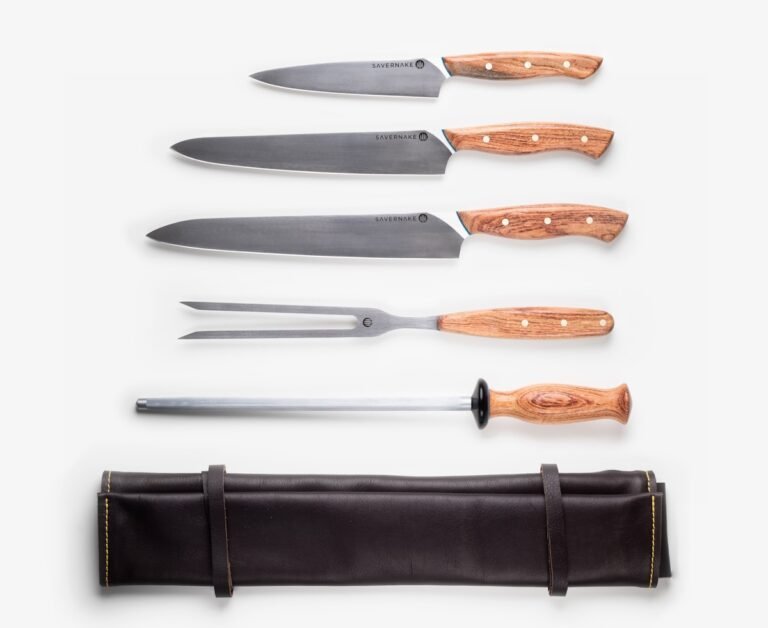
A knife roll is a fabric or leather carrying case that unrolls to reveal individual pockets for each knife. They’re the standard among professional chefs who transport their knives between home and work.
Pros: Knife rolls are portable — you can take your entire collection to a friend’s house, a vacation rental, or a cooking class. They provide the best protection during transport, with each blade separated and padded. When rolled up, they’re compact and can be stored in a cabinet, under a bed, or anywhere else. Canvas and waxed cotton rolls look great and develop character with age.
Cons: They’re terrible for daily kitchen use. Unrolling and re-rolling a knife roll every time you cook gets old fast. The fabric and stitching will eventually wear out with daily use, especially around the blade tips where sharp points press against the material. And because knives are enclosed in fabric, any moisture on the blade before storage can cause rust spots on carbon steel knives. For daily kitchen use, this is the least practical option on the list.
Our pick: The Messermeister 8-Pocket Canvas Knife Roll. Heavy-duty waxed canvas, reinforced stitching at the knife tips, and a buckle closure that’s more secure than ties. At around $35-40, it’s the standard for culinary students and working chefs.
Blade Guards / Edge Guards
The Verdict: Essential for drawer storage, not a standalone solution.
Blade guards (also called edge guards) are plastic or felt-lined sleeves that slide over individual knife blades. They’re not a complete storage solution — they’re a supplement that makes other methods safer.
Pros: Cheap (a 3-pack is usually under $10), universal (they fit most blade shapes), and effective at preventing edge damage and accidental cuts. They’re the only way to safely store knives in a regular kitchen drawer without a dedicated organizer. They’re also useful for protecting knives during transport in a bag or suitcase when you don’t have a roll.
Cons: They trap moisture. If you slide a blade guard onto a knife that’s even slightly damp, you’ll get rust spots within days — especially on carbon steel blades. They also wear out over time as the blade eventually cuts through the plastic or felt lining. And they’re annoying to take on and off repeatedly, so they’re best for knives you use occasionally, not daily drivers.
Important: Always dry knives completely before putting on edge guards. For long-term storage, wipe the blade with a thin coat of food-grade mineral oil before covering. Replace guards when you see cuts in the plastic or worn-through felt — a compromised guard is worse than no guard because it can trap the blade in a way that’s dangerous when you reach in blindly.
Storage Method Comparison
| Method | Edge Protection | Accessibility | Space | Child Safety | Installation | Cost |
|---|---|---|---|---|---|---|
| Magnetic Strip | Good | Best | Counter: none | Poor | Wall-mount | $25-50 |
| Counter Block | Best | Very Good | Counter: yes | Fair | None | $30-100 |
| Drawer Organizer | Very Good | Good | Drawer: yes | Good | None | $20-40 |
| Knife Roll | Very Good | Poor (daily) | Anywhere | Good (stowed) | None | $25-50 |
| Blade Guards Only | Fair | Poor | Drawer (loose) | Poor | None | $5-15 |
Our Recommendation
For most home kitchens, the winning combination is a magnetic strip for your daily-driver knives (chef’s knife, paring knife, maybe a utility knife) and an in-drawer organizer or blade guards for the specialty knives you use less often (bread knife, boning knife, carving knife). This balances instant access for the tools you reach for constantly with protected storage for the tools that come out once a week.
If you have young children and wall-mounted knives aren’t an option, the in-drawer organizer is the best standalone solution — secure, invisible, and kinder to your edges than loose drawer storage. Skip the knife roll unless you’re a mobile professional; it’s the right tool for the wrong job in a permanent home kitchen.
Whatever you choose, stop throwing your knives in a drawer unprotected. Your edges — and your fingers — deserve better.