Knife Sharpening Angle Guide: The Right Edge Angle for Every Blade
Sharpening angle might be the most under-discussed topic in the knife world. Everyone obsesses over steel type and grit progression, but angle selection determines whether your edge lasts a week or a month, whether it chips or rolls, and whether your knife cuts like a laser or a butter knife. Here is everything you need to know about choosing the right sharpening angle.
The Angle-Performance Trade-Off
Knife edges work on a simple principle: lower angles cut better but are weaker. A 12-degree edge slices through food with dramatically less resistance than a 25-degree edge. But that same 12-degree edge will chip or roll under forces that a 25-degree edge shrugs off. The optimal angle is the lowest angle your blade steel and usage pattern can support without premature edge failure.
Think of it like tire pressure on a bicycle. Low pressure gives a smoother ride but risks pinch flats. High pressure rolls faster but transmits every bump. You find the sweet spot for your weight and terrain. Knife angles work the same way.
Complete Angle Reference Chart
| Knife Type | Recommended Angle (per side) | Steel Hardness | Primary Use |
|---|---|---|---|
| Western Chef’s Knife | 18-22° | 56-58 HRC | General kitchen prep, rocking cuts |
| Japanese Gyuto | 12-16° | 60-64 HRC | Precision slicing, push-cutting |
| Santoku / Nakiri | 12-15° | 60-63 HRC | Vegetable chopping |
| Paring Knife | 15-18° | 56-60 HRC | In-hand detail work |
| EDC Pocket Knife | 17-22° | 57-64 HRC (varies) | Mixed daily tasks |
| Bushcraft / Outdoor | 22-28° | 55-60 HRC | Wood processing, batoning |
| Fillet Knife | 12-16° | 56-58 HRC | Fish processing |
| Cleaver / Heavy Chopper | 25-30° | 54-58 HRC | Bone, heavy chopping |
| Straight Razor | 7-10° | 60-64 HRC | Shaving |
Kitchen Knives: The 15° vs 20° Divide
The single most important angle decision in the kitchen is German-style 20° versus Japanese-style 15°. This is not arbitrary — it follows directly from steel hardness and intended cutting technique.
Why German Knives Use 20°
German steel (X50CrMoV15 in Wüsthof and Zwilling) is hardened to approximately 57-58 HRC. At this hardness, the steel is tough but not exceptionally wear-resistant. A 20° edge provides enough material behind the apex to resist rolling during rocking-chopping motions and incidental contact with bones and cutting boards. A German knife sharpened to 15° will cut beautifully for about one meal prep before the edge rolls.
Wüsthof Classic 8-Inch Chef’s Knife on Amazon →
Why Japanese Knives Use 15° (or Lower)
Japanese steel (VG-10, Aogami Super, SG2/R2) hardens to 60-64 HRC. At this hardness, the steel supports thinner edge geometry without rolling. The 15° (or lower) angle takes full advantage of the steel’s hardness to deliver the laser-like cutting experience Japanese knives are famous for. The trade-off is chipping risk — lateral force that would roll a German edge can chip a Japanese one.
EDC and Pocket Knives: Steel Dictates Angle
Pocket knife edge angles are more variable than kitchen knives because the steel varieties span a massive range of hardness and toughness. General guidelines by steel class:
- Budget stainless (8Cr13MoV, AUS-8, 14C28N): 20-22° per side. Softer steels need thicker edge geometry for durability.
- Mid-range (D2, 9Cr18MoV, VG-10): 18-20° per side. D2 can run slightly thinner due to higher wear resistance.
- Premium stainless (S30V, S35VN, S45VN): 17-20° per side. These steels support thinner edges while resisting wear.
- Super steels (M390, 20CV, MagnaCut): 15-18° per side. High hardness and wear resistance allow very acute angles, though MagnaCut’s exceptional toughness means you can go even lower if you are careful.
Outdoor and Hard-Use Knives: Prioritize Toughness
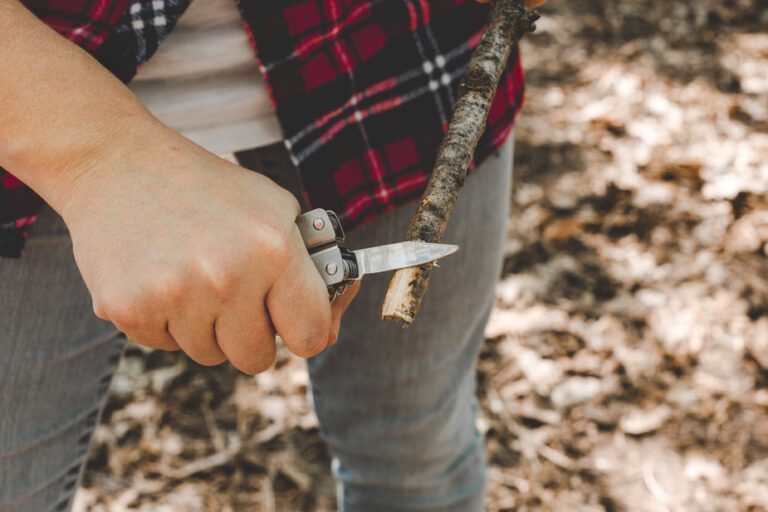
Bushcraft and outdoor knives need edge angles that prioritize durability over slicing performance. You are not dicing onions — you are feather-sticking kindling, processing firewood, and possibly batoning through logs. A 25° edge on a bushcraft knife will survive tasks that destroy a 17° edge. The Mora Companion, one of the most respected budget bushcraft knives, ships with a roughly 23-25° Scandinavian (“Scandi”) grind — and there is a reason for that.
How to Know Your Current Angle
The Sharpie Trick
Color the edge bevel with a black Sharpie marker. Make one light pass on your stone at your estimated angle. The Sharpie removal pattern tells you everything: if only the shoulder (top of the bevel) shows clean metal, your angle is too low. If only the very edge shows clean metal, your angle is too high. If the entire bevel shows clean metal, your angle is correct. This is the single most useful sharpening diagnostic technique and it costs exactly one Sharpie.
Angle Guides
Plastic angle guide wedges (available in sets with 15°, 17°, 20°, 22°, 25°) let you physically feel the correct angle. Place the wedge on your stone, rest the blade against it, and memorize that wrist position. After enough repetitions, your muscle memory takes over.
Sharpening Angle Guide Wedges on Amazon →
Micro-Bevels: The Advanced Technique
A micro-bevel is a very small secondary bevel at a slightly higher angle than the primary edge. Typically 2-3 degrees higher, applied with just a few light strokes. The micro-bevel increases edge stability without significantly affecting cutting performance because the primary bevel still determines the overall geometry. Think of it as reinforcing the very tip of the edge while maintaining the thin cross-section behind it.
Micro-bevels are particularly useful on Japanese kitchen knives that see occasional abuse and on EDC knives made from high-hardness steels. The technique adds significant chipping resistance with almost no loss of perceived sharpness.
Bottom Line
Angle selection is not guesswork — it follows directly from your knife’s steel hardness and your intended use. German kitchen knives at 20°, Japanese at 15°, pocket knives at 17-22° depending on steel class, outdoor knives at 22-28°. Use the Sharpie trick to verify, then practice until the angle becomes automatic. Your edges will last longer and cut better.
Disclosure: BladeOwl participates in the Amazon Services LLC Associates Program. As an Amazon Associate, we earn from qualifying purchases at no additional cost to you.