Victorinox Fibrox Pro Review — The Best Budget Chef Knife? (2026)
The Knife That Outperforms Its Price Tag
If you walk into any professional kitchen in America — from Michelin-starred restaurants to corner diners — you’ll see the same knife on the prep line: a black-handled chef’s knife with the word “Victorinox” stamped into the blade. It’s not the most expensive, not the prettiest, and definitely not the kind of knife that Instagram chefs pose with. But it might be the best value in the entire world of cutlery, and after putting one through months of daily use, we understand exactly why it’s the industry standard.
The Victorinox Fibrox Pro 8-Inch Chef’s Knife — sometimes called the “Swiss Army Knife of chef’s knives” — has been in production for decades, yet it’s still the default recommendation for new cooks, culinary students, and anyone who wants one knife that can do everything. Here’s our detailed review after putting it to work in a busy home kitchen alongside knives that cost three to five times as much.
Specifications at a Glance
| Spec | Detail |
|---|---|
| Blade Length | 7.9 inches (200mm) |
| Overall Length | 13.5 inches |
| Weight | 6.8 oz (193g) |
| Steel | X50CrMoV15 (proprietary Swiss formulation) |
| Hardness | 55-56 HRC |
| Construction | Stamped (not forged) |
| Handle | Thermoplastic elastomer (Fibrox) |
| Tang | Partial (not full, not rattail) |
| Edge Angle | ~15 degrees per side (double bevel) |
| Origin | Switzerland |
| Warranty | Lifetime against defects |
Blade Performance: Sharp, Light, and Surprisingly Capable
The Victorinox arrives sharp out of the box — sharper than many knives costing three times as much. The blade geometry is a classic Western-style chef’s profile with a gentle belly curve that works equally well for rocking cuts and push cuts. At 6.8 ounces, it’s noticeably lighter than forged German knives like the Wusthof Classic (8.5 ounces) or Zwilling Pro (9.5 ounces). This weight difference is divisive: some cooks love the nimble, almost Japanese-like feel, while others miss the heft that helps a heavier knife power through dense vegetables.
We found the lighter weight to be a net positive during long prep sessions. After dicing three pounds of onions and breaking down six chickens, our wrists felt noticeably less fatigued than with heavier German knives. The trade-off is that the Victorinox requires slightly more deliberate cutting on hard vegetables like butternut squash — you can’t just let the weight of the blade do the work.
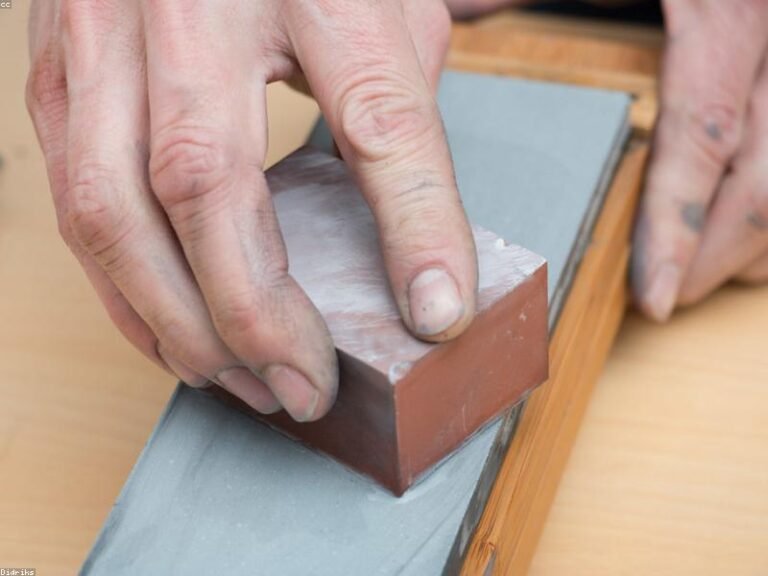
The blade steel is Victorinox’s proprietary formulation of X50CrMoV15, the same class of steel used by Wusthof, Zwilling, and most Solingen manufacturers. Victorinox runs it slightly softer than the German competition — around 55-56 HRC versus Wusthof’s 58 HRC — which means the edge dulls slightly faster but is significantly easier to sharpen. For a home cook who sharpens their own knives, this is actually an advantage. A few strokes on a honing steel before each use and a touch-up on a 3000-grit whetstone every month keeps the Victorinox performing within spitting distance of day-one sharpness. The softer steel is also more resistant to chipping — we’ve seen Wusthof and Shun knives develop micro-chips from cutting around bones, while the Victorinox simply rolls slightly and can be honed back to true.
The Fibrox Handle: Love It or Replace It
The Fibrox handle is the most divisive feature of this knife. Made from thermoplastic elastomer (TPE) molded over the partial tang, the Fibrox handle has a pebbled texture that provides extraordinary grip — even with wet hands covered in chicken fat, the knife stays securely in your hand. This is the primary reason professional kitchens choose the Fibrox over the fancier Victorinox Swiss Modern (walnut handle) or Rosewood versions: grip matters more than aesthetics when you’re working fast in a slippery environment.
The handle shape is simple and effective. It’s contoured enough to prevent your hand from sliding forward onto the blade (there’s no bolster, so the heel of the blade is fully exposed), but neutral enough to accommodate any grip style. The material is dishwasher-safe — though we strongly recommend hand-washing any knife — and it’ll survive years of commercial kitchen abuse without cracking or degrading.
The downside: the Fibrox handle feels, honestly, a little cheap. It’s molded plastic, and it looks and feels like molded plastic. In a home kitchen with wooden countertops and handcrafted cutting boards, the Fibrox handle stands out like a plastic fork at a dinner party. If aesthetics matter to you, Victorinox offers the same blade with a Swiss Modern handle (walnut wood) for about $20 more. Same performance, nicer look, slightly less grip.
Stamped vs. Forged: The Debate That Doesn’t Matter
The Victorinox Fibrox is stamped, not forged. In the knife world, this is often presented as “forged = better,” but the reality is more nuanced. Forging involves heating a billet of steel and hammering it into a blade shape, which aligns the steel’s grain structure for improved toughness and allows features like a full bolster and tapered tang. Stamping involves cutting a blade shape out of a sheet of steel using a die, like a cookie cutter, then grinding and heat-treating the result.
The material difference in modern knives is smaller than the marketing suggests. Victorinox’s stamped blades are heat-treated to the same standards as many forged knives, and the blade geometry — the thinness behind the edge, the taper, the distal taper — matters more for cutting performance than whether the blade was hammered or stamped. The Fibrox’s blade is uniformly thin (about 2mm at the spine, with a full flat grind), which makes it a better slicer than many thicker forged knives in the same price range.
The practical trade-offs of stamped construction are: (1) no bolster, which makes sharpening easier but sacrifices some finger protection; (2) slightly lighter weight, which is personal preference; and (3) a thinner blade overall, which favors slicing over heavy chopping. For home cooking, these are all neutral or positive trade-offs.
Head-to-Head Comparisons
Victorinox Fibrox vs. Wusthof Classic 8-Inch Chef’s Knife
The Wusthof Classic is the benchmark German chef’s knife — forged, full-bolstered, triple-riveted, and three times the price of the Victorinox. In a head-to-head cutting test, the differences are smaller than you’d expect. The Wusthof holds an edge longer (58 HRC vs 56 HRC), feels more substantial in hand (which is either good or bad depending on preference), and has a more refined fit and finish. The Victorinox is lighter, easier to sharpen, and — critically — costs $170 less. For a home cook who’s willing to hone their knife before use and touch it up monthly, the Victorinox delivers 90% of the Wusthof’s performance for 25% of the price.
Where the Wusthof unmistakably wins: aesthetics, longevity (it’s a knife you hand down to your kids), and heavy-duty tasks like splitting winter squash. Where the Victorinox wins: value, grip security, and ease of sharpening.
Check Wusthof Classic on Amazon →
Victorinox Fibrox vs. Mercer Culinary Genesis 8-Inch Chef’s Knife
The Mercer Genesis is the closest competitor at a similar price point (~$40). The Genesis uses a forged blade with a full tang and a Santoprene/polypropylene handle, and it’s the knife most culinary schools issue to students as an alternative to the Victorinox. In side-by-side testing, the Mercer is slightly heavier and has a more pronounced belly curve that favors rocking cuts. The Victorinox is lighter, has a slightly flatter profile that favors push cuts and chopping, and has better edge retention out of the box. Both are excellent values, and the choice comes down to cutting style preference.
Check Mercer Genesis on Amazon →
Comparison at a Glance
| Knife | Construction | Price Tier | Best For |
|---|---|---|---|
| Victorinox Fibrox Pro 8″ | Stamped | Budget (~$45) | Best overall value; lightweight, grippy, easy to sharpen |
| Wusthof Classic 8″ | Forged | Premium (~$170-200) | Buyers who want a heavier, heirloom-quality forged knife |
| Mercer Culinary Genesis 8″ | Forged | Budget (~$40) | Culinary students who want a full-tang forged knife at a similar price to the Fibrox |
Who Should Buy the Victorinox Fibrox?
The Victorinox Fibrox is ideal for:
- New cooks: If you’re building your first real kitchen, this is the chef’s knife to buy. It’s forgiving to learn sharpening on, provides excellent grip while you develop knife skills, and costs less than a nice dinner out.
- Budget-conscious enthusiasts: You know your way around a kitchen but don’t want to spend $150 on a single knife. The Victorinox gives you professional-grade performance at a price that leaves budget for a good whetstone, paring knife, and bread knife.
- High-volume home cooks: If you cook every night and do weekly meal prep, the lightweight design and grippy handle reduce fatigue during long prep sessions.
- Anyone with hand strength or dexterity concerns: The Fibrox handle provides more secure grip than wood or polished synthetic handles, making it a great choice for cooks with arthritis or reduced grip strength.
It’s not ideal for:
- Aesthetics-focused cooks: If you want a knife that looks beautiful on a magnetic strip, this isn’t it. The Rosewood or Swiss Modern versions are better choices.
- Heavy-knife preference: If you prefer the weight-forward feel of a forged German knife, the Victorinox will feel too light.
- “Buy it for life” sentiment: While the Victorinox will last decades with proper care, it doesn’t carry the heirloom feel of a forged Wusthof or a handcrafted Japanese knife. It’s a tool, not a treasure.
The Verdict
The Victorinox Fibrox Pro 8-Inch Chef’s Knife is, dollar for dollar, the best chef’s knife you can buy. It’s not the best chef’s knife — the Wusthof Classic outlasts it, a hand-forged Japanese gyuto out-cuts it, and a custom knife from a master bladesmith outclasses it in every way except price. But for $45, you get a Swiss-made knife that performs at a level that would be impressive at twice the price. It’s the knife we recommend to anyone who asks “what chef’s knife should I buy?” — and we’ve never had someone come back and say we steered them wrong.
Check Victorinox Fibrox Pro on Amazon →
This article may contain affiliate links. If you purchase a product through one of these links, Bladeowl may earn a commission at no extra cost to you. This never influences our editorial independence or which products we recommend.