
How to Maintain Your EDC Knife: Complete Cleaning and Care Guide
Your EDC knife is an investment — and like any investment, it needs regular care to perform at its best. A well-maintained knife will last decades, while a neglected one can develop rust, lock issues, and poor action in a matter of months. This comprehensive maintenance guide covers everything from daily wipe-downs to full disassembly and tuning.
Why Maintenance Matters
Pocket knives live in a harsh environment. They collect dust, lint, and moisture in your pocket. They cut through tape residue, food, cardboard, and countless other materials that leave deposits on the blade and in the mechanism. Without regular maintenance, the pivot becomes gritty, the lock becomes sticky, and the blade can develop rust spots — even on stainless steels.
Regular maintenance does more than preserve your knife — it makes it safer and more enjoyable to use. A clean, sharp, well-tuned knife deploys smoothly, locks securely, and cuts efficiently.
Daily and Weekly Maintenance
Wipe Down the Blade
After each day of carry, take 30 seconds to wipe the blade with a microfiber cloth or paper towel. This removes moisture, skin oils, and any residue from cutting tasks. It is the single most effective habit for preventing corrosion.
If you cut food with your knife, clean the blade with warm water and mild soap, then dry thoroughly. Food acids and salts are particularly corrosive, even to stainless steel.
Check for Pocket Lint
Inspect the area around the pivot and lock mechanism for accumulated lint. A can of compressed air is excellent for blasting out debris without disassembly. Hold the knife open and spray into the pivot area, lock interface, and any crevices where lint collects.
Apply Lubricant
A drop of quality knife lubricant in the pivot area keeps the action smooth. Nano-oil, KPL (Knife Pivot Lube), and Tuf-Glide are excellent choices. Apply a small drop to each side of the pivot, work the blade open and closed several times, then wipe away any excess. Over-lubrication attracts dirt.
Monthly Deep Cleaning
Flush the Pivot
Even with daily care, debris builds up inside the pivot over time. Once a month, flush the pivot area with a solvent like isopropyl alcohol or a dedicated knife cleaner. Apply the solvent generously while working the blade, then blow out with compressed air. Follow with a drop of fresh lubricant.
Inspect the Lock
Check the lock engagement when the blade is open. On a liner lock or frame lock, the lock bar should engage at least 25 percent of the blade tang, ideally 40 to 60 percent. If the lock bar travels all the way across, the lock may be approaching failure. On a crossbar lock, verify the bar seats evenly on both sides. On a back lock, confirm the rocker arm is fully engaged with the blade notch.
Clean the Handle Scales
G-10, micarta, and FRN handles accumulate skin oils and dirt. Clean them with warm water and a soft brush. Micarta in particular absorbs oils and will darken over time — some users appreciate this patina, while others prefer to keep it clean. For G-10, a toothbrush with mild soap restores the grip texture.
Full Disassembly Guide
Full disassembly should be done every six months to a year, or whenever the action feels gritty despite flushing. While it can seem intimidating, most folding knives are designed to be disassembled for maintenance.
Tools You Will Need
– Quality Torx driver set (T6, T8, and T10 cover most knives)
– Pivot tool or adjustable wrench (for some designs)
– Clean work surface with good lighting
– Small container for screws
– Isopropyl alcohol (90 percent or higher)
– Compressed air
– Quality lubricant
– Thread locker (blue Loctite, optional)
– Microfiber cloths
Disassembly Steps
1. Lay out a clean towel or mat on your work surface. This prevents small parts from bouncing away and provides contrast to see screws.
2. Close the blade and remove all body screws. Most knives use T6 torx for body screws. Place screws in a container or arranged on the mat in the pattern they were removed from — this makes reassembly much easier.
3. Remove the pivot screw. This is typically a T8 or T10. Some knives have a free-spinning pivot that requires a pivot tool to hold the opposite side. If the pivot spins freely, use a second driver or pivot tool to hold the female side.
4. Carefully separate the handle scales. On liner lock knives, the liner may be captured between the scale and blade. On frame lock knives, the show side scale typically comes off first.
5. Remove the blade and washers. Pay attention to washer orientation — some are directional. Bronze phosphor washers have a smooth side and a slightly textured side. The smooth side typically faces the blade. If your knife uses ball bearings in cages, note which way the cage faces.
6. Clean every component thoroughly. Wipe all parts with isopropyl alcohol and a lint-free cloth. Use compressed air to blow out the screw holes and any areas you cannot reach with a cloth. Pay special attention to the blade tang where the lock bar engages, as old lubricant and debris accumulate there.
7. Inspect for wear. Check washers for flatness, the blade tang for deformation, and lock surfaces for uneven wear. Replace any damaged components.
Reassembly Steps
1. Apply a tiny drop of lubricant to each washer or bearing surface. Less is more — excess lubricant attracts dirt.
2. Place the washers on the blade pivot, then position the blade between the handle scales. This is the trickiest part and may require several attempts. Take your time.
3. Insert the pivot screw and tighten until the blade still moves with slight resistance. Do not fully tighten yet.
4. Install body screws loosely, then work your way around tightening them evenly. Avoid over-tightening, especially on G-10 which can crack.
5. Adjust the pivot tension. Tighten until blade play disappears, then back off slightly until the blade swings freely. This is the sweet spot between no play and smooth action.
6. Apply a single small drop of lubricant to the pivot and work the blade 20 to 30 times to distribute it.
7. Test the lock engagement and check blade centering. If the blade is off-center, slight adjustments to the pivot and body screw tension can often correct it.
Sharpening
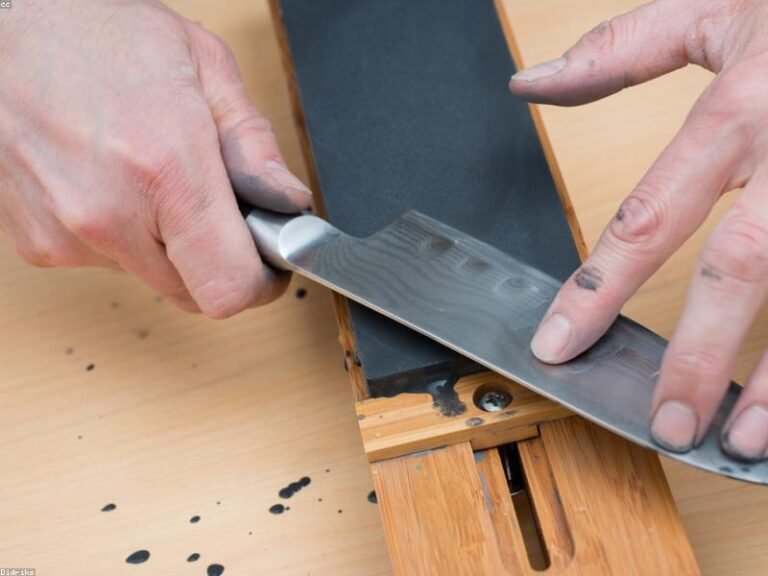
A sharp knife is a safe knife. A dull blade requires more force to cut, increasing the chance of slips and accidents. Maintain your edge with regular touch-ups:
– Strop weekly: A leather strop with green compound realigns the microscopic edge and keeps the knife sharp between full sharpenings. Five to ten passes per side is usually sufficient.
– Touch up monthly: A ceramic rod or fine stone can restore a slightly dulled edge in minutes.
– Full sharpening as needed: When stropping no longer restores the edge, it is time for a full sharpening session. For premium steels, invest in quality stones or a guided system.
Find sharpening gear: Knife Sharpening Supplies
Rust Prevention and Removal
Prevention
Keep the blade dry and clean. In humid environments, apply a thin coat of mineral oil or a dedicated rust preventative like Tuf-Cloth or Sentry Solutions Tuf-Glide. Food-safe mineral oil is ideal for knives used in food preparation.
Removal
Light surface rust can be removed with a pencil eraser, fine steel wool (0000 grade), or metal polish like Flitz or Mothers. Apply gently and work in the direction of the existing grind lines. For deeper rust, a rust eraser or fine-grit sandpaper may be necessary, but this will alter the blade finish.
For severely rusted blades, consider professional restoration services.
Storage
When not carrying your knife, store it properly:
– Keep knives in a dry environment. A Pelican case with desiccant packs is ideal for collections.
– Do not store knives in leather sheaths long-term — leather absorbs moisture and promotes rust.
– For long-term storage, apply a protective coat of oil or rust inhibitor.
– Store folding knives in the open position to relieve spring tension on the lock mechanism.
Recommended Maintenance Products
– KPL (Knife Pivot Lube): Premium lubricant available in light, medium, and heavy weights
– Nano-Oil: Excellent lubricant with nano-particles that fill microscopic pores in metal
– Tuf-Cloth: Marine-grade rust preventative cloth
– Wiha Torx Drivers: The gold standard for knife maintenance tools
– Compressed Air: Invaluable for flushing debris from pivots
Shop maintenance supplies on Amazon: Knife Maintenance Kit
Conclusion
Regular maintenance is not just about preserving your investment — it is about respecting the tool that serves you every day. A few minutes of care each week keeps your EDC knife operating smoothly, looking great, and ready for whatever task comes next. Start with the daily wipe-down habit, and build up to monthly deep cleaning and periodic sharpening. Your knife will reward you with decades of reliable service.
Find your next EDC knife and maintenance gear: EDC Knives and Accessories
This article may contain affiliate links. If you purchase a product through one of these links, Bladeowl may earn a commission at no extra cost to you. This never influences our editorial independence or which products we recommend.