
How to Tell When Honing Isn’t Enough and You Need to Sharpen
A honing steel gets pulled out before almost every serious cooking session, but it can’t fix everything. Knowing the difference between an edge that’s simply out of alignment and one that’s genuinely dull is the single most useful skill for keeping a knife performing well, because reaching for the wrong tool at the wrong time wastes time and, in some cases, does more harm than good.
What Honing Actually Does
A honing rod doesn’t remove metal in any meaningful amount. What it does is push a microscopically bent or rolled edge back into alignment. Every time a blade contacts a cutting board, bone, or anything harder than the food itself, the thin apex of the edge can fold slightly to one side. That fold is invisible to the eye but it changes how the edge meets food, and a few passes on a steel realigns it so the edge is standing straight again. This is maintenance, not sharpening, and it should happen often – many cooks hone before every use.
Signs You’re Dealing With Misalignment, Not Dullness
A knife that’s merely out of alignment usually shows a specific pattern: it was cutting well recently, performance dropped off somewhat suddenly rather than gradually, and a few strokes on the steel bring it right back. The edge will still catch on a fingernail (lightly, and carefully) at most points along its length, just inconsistently.
Signs the Edge Is Actually Dull
True dullness shows up differently, and there are a few reliable tests that don’t require any special equipment. The classic one is the tomato test: a sharp edge should drop into the skin of a ripe tomato under almost no downward pressure, using a light slicing motion. If the blade instead squashes the tomato or needs noticeable force to break the skin, the edge has lost its bite. Paper is another good indicator – slicing through a sheet of printer paper held in the air should produce a clean cut, not a tear or a snag partway through.
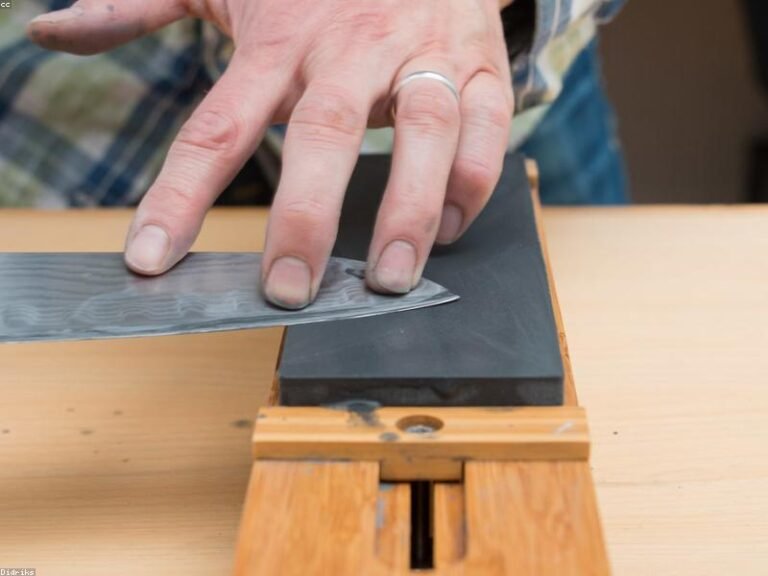
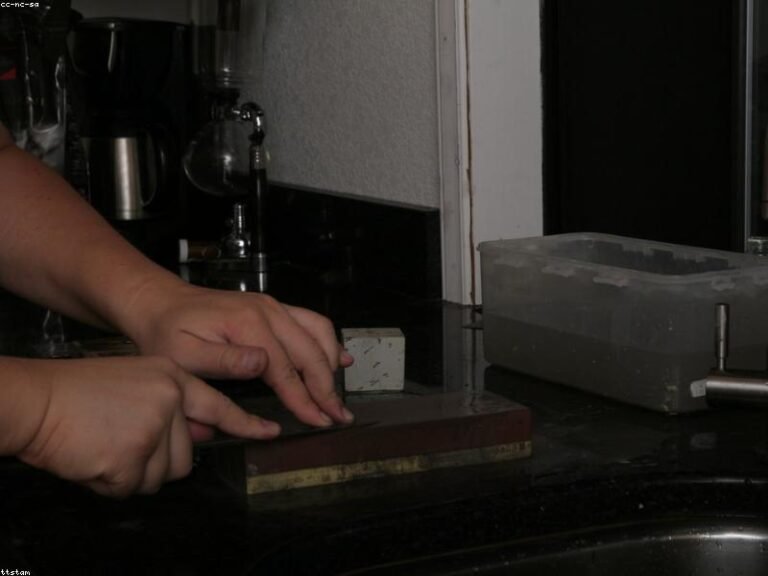
The visual test is just as telling. Angle the edge under a strong light and look down the length of the blade. A sharp edge is so thin it won’t reflect light back at you; it essentially disappears. A dull or rolled edge, on the other hand, has enough flat width remaining at the very apex to catch and bounce light back as a visible bright line. If honing doesn’t make that line go away, metal actually needs to be removed to form a new apex, which is what sharpening (on a whetstone, pull-through system, or by a professional) accomplishes.
Why the Distinction Matters
Honing a knife that’s actually dull wastes effort and can create a false sense of security, since the edge feels marginally straighter without regaining any cutting ability. Sharpening a knife that only needed honing, on the other hand, removes steel unnecessarily and shortens the practical lifespan of the blade, since every sharpening session takes a small amount of material off permanently. Reaching for a stone only when the light test, the paper test, or the tomato test all point to a genuinely worn edge – rather than on a fixed schedule – keeps a knife in service far longer while still cutting the way it should every time it’s picked up.
This article may contain affiliate links. If you purchase a product through one of these links, Bladeowl may earn a commission at no extra cost to you. This never influences our editorial independence or which products we recommend.