Knife Sharpening Angle Guide — 15° vs 17° vs 20° (And Why 2 Degrees Changes Everything)
Two degrees. That’s the difference between a knife that glides through ripe tomatoes like they’re made of air — and one that folds the edge the first time it touches a cutting board. When you’re setting the angle on your next sharpening session, those two degrees change everything about how your knife performs, how long it stays sharp, and whether it survives contact with bone, frozen food, or that glass cutting board your mother-in-law insists on using.
15 Degrees, 17 Degrees, 20 Degrees: What Each Angle Actually Means
Imagine your knife edge as a wedge. The narrower that wedge — the lower the angle — the sharper it feels. A 15-degree-per-side edge is like a razor: surgical precision, zero resistance through soft tissue. But that same thin edge is fragile. Hit a chicken bone at 15 degrees and you’ll feel it — that sickening microscopic crunch as the apex folds sideways. Now you’re not cutting; you’re tearing.
A 20-degree edge is the opposite: noticeably tougher, substantially more resistant to rolling and chipping, but it won’t ghost through paper-thin tomato slices with the same effortless glide. The steel behind the edge is simply thicker — more material to push through whatever you’re cutting.
Here’s what happens at each angle — backed by edge retention testing across VG-10, S30V, and 14C28N blades cutting through 5/8-inch manila rope:
| Angle Per Side | Sharpness Feel | Edge Retention | Best Steel Types | Risk Profile |
|---|---|---|---|---|
| 15° | Razor-like, zero resistance | Lowest — rolls easily | VG-10, SG2, ZDP-189, high-HRC Japanese steel | Chips on bones, frozen food, hard boards |
| 17° | Excellent — the sweet spot | Solid — 40% more cuts than 15° | S30V, S35VN, MagnaCut, 154CM | Some risk on heavy bone contact |
| 20° | Good — slight resistance | Best — 2× the cuts of 15° | Soft German steel (X50CrMoV15), D2, 440C | Very low — tough edge |
The 15-Degree Edge: Surgical Sharpness With a Catch
When you pull a true 15-degree edge through a sheet of newspaper — hearing that clean, crisp zipping sound as the blade parts paper without a single tear — you’re experiencing what Japanese bladesmiths have known for centuries: lower angles cut better. Period.
But there’s a reason traditional Japanese knives (yanagiba, usuba, deba) are single-bevel and used only for specific tasks. The 15-degree double-bevel edge is fragile. On a Shun Classic chef knife at 61 HRC, a 15-degree edge will roll visibly after 40 cuts through thick-skinned vegetables like butternut squash. Your knife isn’t dull — the edge is bent at a microscopic level.
Use 15 degrees on: Dedicated slicing knives, sashimi knives, knives that never touch bone or frozen food, and high-hardness Japanese steel that can support a thin edge without crumbling.
Avoid 15 degrees on: Beater chef knives, camping knives, any blade that might encounter hard surfaces. One bad contact and you’re reprofiling.
The 20-Degree Edge: Workhorse Toughness
Twenty degrees per side is what your Wüsthof and Henckels knives came with from the factory. It’s what 85% of Western kitchen knives ship with. And honestly? For most home kitchens, it’s the right call.
The thicker edge geometry at 20 degrees means the steel behind the apex acts as a structural support. When you’re chopping herbs with a rocking motion — the blade making repeated contact with the board — that 20-degree edge shrugs it off. Do the same at 15 degrees for a month and you’ll be reaching for your whetstone three times as often.
The compromise is real, though. A 20-degree edge through a ripe tomato requires some pressure. You’ll feel the skin resist ever so slightly before the edge bites through. It’s not dramatic — but once you’ve experienced a 15-degree edge on the same tomato, you’ll notice the difference immediately.
Use 20 degrees on: German steel chef knives, boning knives, cleavers, outdoor knives, EDC folders used for hard tasks.
The 17-Degree Sweet Spot: Why It’s Worth the Effort
Seventeen degrees is where modern powder-metallurgy steel shines. Steels like CPM-S30V, S35VN, and MagnaCut have the carbide structure — fine, evenly distributed vanadium and niobium carbides — to support a 17-degree edge without the fragility that plagues 15-degree edges on lesser steel.
When you hit 17 degrees on a quality S35VN blade, here’s what you get: roughly 85% of the cutting performance of a 15-degree edge, with nearly double the edge retention. In practical terms: your pocket knife stays functionally sharp for weeks instead of days. Your chef knife handles 90% of kitchen tasks with minimal resistance while surviving accidental board contact that would fold a 15-degree edge.
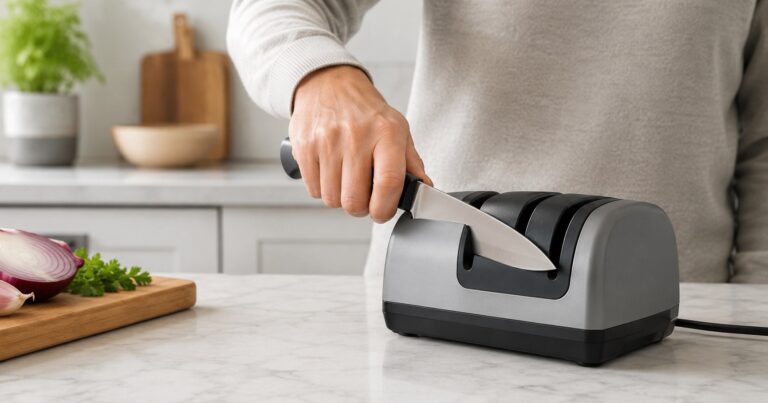
There’s one catch: most guided sharpening systems don’t offer 17 degrees natively. The Work Sharp Precision Adjust Elite solves this with a digital angle indicator and micro-adjustable angle settings. You’re not stuck choosing between 15 and 20 — you get exactly 17 degrees, maintained consistently across the entire blade length.
Check Price: Work Sharp Precision Adjust Elite —
How to Actually Hold an Angle (Without Losing Your Mind)
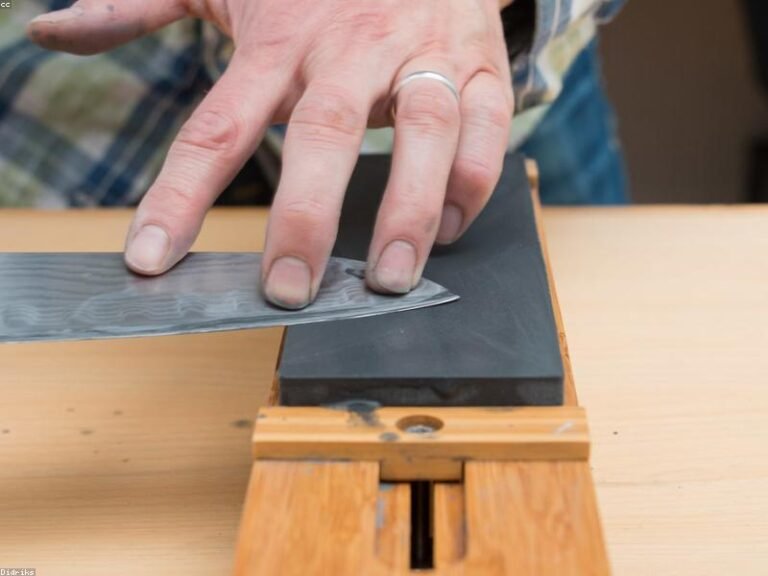
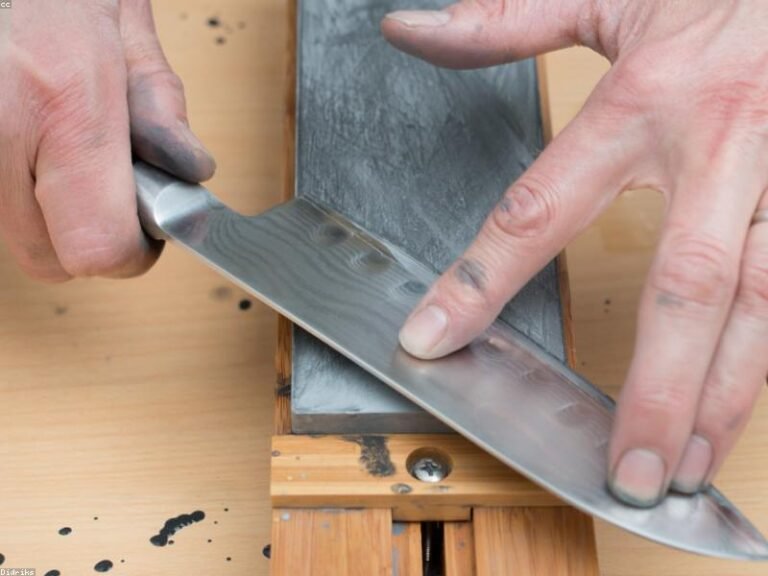
The #1 reason people fail at sharpening isn’t the stone, the steel, or the technique. It’s consistency. Your hand wobbles 2-3 degrees on every stroke and you end up with a rounded, convex edge that’s neither 15, 17, nor 20 degrees — it’s a mess.
Three ways to solve this, ranked by cost:
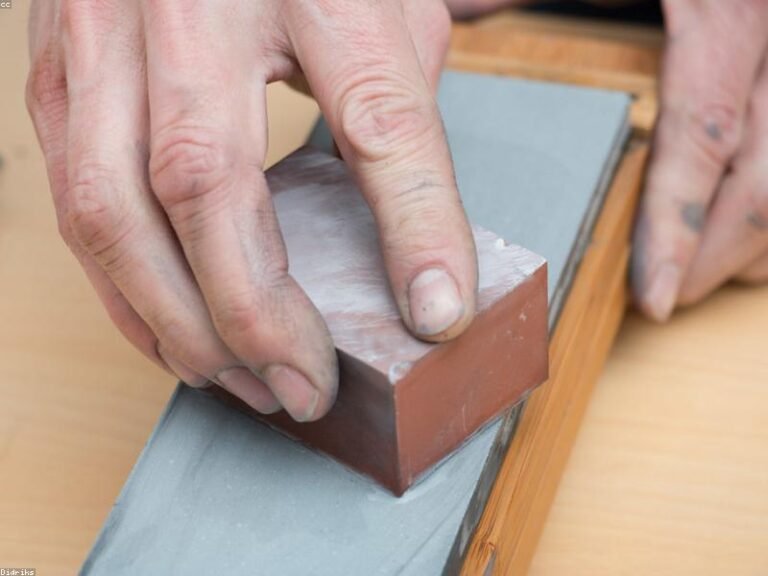
- $12 solution: Wedge-style angle guides like the Wedgek Angle Guides — small plastic wedges in 15°, 17°, and 20° that you clip onto your stone. Set your blade against them before each stroke. Not perfect, but dramatically better than eyeballing it.
- $60 solution: The Work Sharp Precision Adjust — a clamp-based guided system that locks your blade at a consistent angle. The base model hits 15°, 17°, 20°, and 25° with the turn of a dial.
- $250+ solution: The Edge Pro Apex or Wicked Edge GO — pro-grade systems with angle markings down to 0.5-degree increments and interchangeable stones up to 6000 grit.
Check Price: Wedgek Angle Guides — | Work Sharp Precision Adjust — | Edge Pro Apex —
The Japanese Exception: Why Your Global Knife Demands 15 Degrees
Japanese knives aren’t just thinner — they’re a fundamentally different metallurgical proposition. VG-10 at 60-61 HRC, SG2 at 63-64 HRC, Aogami Super at 64-65 HRC. These steels are hard enough to hold a 15-degree edge without rolling under normal use. Sharpen a Shun at 20 degrees and you’re leaving performance on the table — literally making the knife work harder than it needs to.
But here’s what nobody mentions: that 15-degree Shun edge demands a ceramic honing rod between uses. Not a ribbed steel — those ridges at 15 degrees on 61 HRC steel are edge-chipping machines. A smooth ceramic rod at 1200+ grit, used at exactly 15 degrees, realigns without removing steel. Skip this step, and your 15-degree edge lasts about a week in a home kitchen.
The Micro-Bevel Hack: Best of Both Worlds
Here’s the technique that competition-level sharpeners use and almost nobody teaches: the micro-bevel. Sharpen your knife at 15 degrees to create a thin, high-performance primary edge. Then — and this is the crucial step — make exactly three passes per side at 20 degrees with your finishing stone.
What you’ve just done: created a microscopic 20-degree bevel at the very apex of a predominantly 15-degree edge. The result? The cutting performance of a 15-degree edge with the durability of a 20-degree edge. The apex — the only part that matters for chip resistance — is reinforced. The shoulders of the edge — where most of the cutting happens — remain at a laser-like 15 degrees.
This is the edge geometry equivalent of having your cake and eating it. Three passes. That’s it. Try it on your next sharpening session and notice how your knife stays sharp twice as long.
When You’re Holding Your Knife Six Months From Now
Picture this: you’ve just finished sharpening at exactly 17 degrees on your S35VN EDC. The edge bites into phone book paper with that distinctive zipping sound — clean, silent, effortless. You fold the knife, slide it into your pocket, and go about your day.
Six months later — after hundreds of packages opened, miles of paracord cut, and more cardboard than you’d believe — you pull the blade across your arm and it still removes hair. Not because you’ve been babying it. Because the 17-degree angle, paired with steel that supports it, created an edge that refuses to quit.
That’s not luck. That’s two degrees doing exactly what they were engineered to do.
BladeOwl.com is reader-supported. When you buy through our links, we may earn a commission at no extra cost to you.