How to Read a Knife Spec Sheet — Blade Steel, HRC, Grind Types, and What Actually Matters
You’re scrolling a knife listing. The description says “CPM-S30V blade at 60 HRC with a full-flat grind and titanium frame lock.” Cool. So… is that good? Should you spend $200 on it or $50?
Knife spec sheets are dense with jargon by design. The industry knows that throwing acronyms and numbers at you creates a perception of quality — whether the knife deserves it or not. I’ve seen $30 knives with spec sheets that read like NASA engineering documents, and $200 knives with three sentences and a blurry photo.
The goal of this guide: you’ll be able to glance at any knife listing and know, within 30 seconds, whether it’s worth the asking price. No metallurgy degree required.
Blade Steel — The Heart of Every Knife
If you learn one thing from this guide, make it blade steel. The steel determines edge retention (how long it stays sharp), toughness (resistance to chipping), corrosion resistance (will it rust), and sharpenability (how hard it is to bring back an edge).
Here’s the catch: no steel excels at everything. It’s always a trade-off.
The Steel Quadrant — Pick Your Priority
Think of blade steel on a 4-axis chart:
- Edge Retention = Toughness — Harder steels hold an edge longer but chip more easily.
- Corrosion Resistance = Edge Retention — Stainless steels sacrifice some edge stability for rust resistance.
- Sharpenability = Edge Retention — Easy-to-sharpen steels (like 12C27) dull faster.
- Price = Usually everything — Powder metallurgy steels (CPM-S30V, S45VN, M390) cost more because the manufacturing process creates a finer, more uniform carbide structure.
Steel Tier List — Quick Reference
| Tier | Steels | Edge Retention | Toughness | Corrosion Resistance | Typical Knife Price |
|---|---|---|---|---|---|
| Budget | 8Cr13MoV, 420HC, AUS-8, 12C27 | Low-Medium | High | Medium-High | $20–$60 |
| Mid-Range | D2, VG-10, 154CM, 14C28N, Nitro-V | Medium | Medium-High | Medium-High | $50–$120 |
| Premium | S30V, S35VN, S45VN, SPY27, Elmax | High | Medium | High | $120–$250 |
| Super Steel | M390, 20CV, 204P, MagnaCut, Vanax | Very High | Medium-High | Very High | $200–$500+ |
The real-world translation: For EDC use — opening boxes, cutting zip ties, food prep — D2 or 14C28N is already overkill. S30V is luxury. M390 is showing off. Don’t let anyone tell you that 8Cr13MoV is “garbage” — properly heat-treated, it’s a perfectly functional steel that 90% of users will never outgrow.
What Is “CPM” and Why Does It Matter?
CPM stands for Crucible Particle Metallurgy — a manufacturing process where the steel is atomized into tiny droplets and rapidly cooled before being compressed under extreme heat and pressure. The result: a finer, more uniform grain structure that eliminates the large carbides found in conventionally cast steel.
Practical difference: CPM-S30V vs. conventionally cast 440C might both hit 60 HRC, but the S30V will hold an edge 30-50% longer and be less prone to chipping because the carbides are smaller and evenly distributed.
Powder metallurgy steels worth knowing: CPM-S30V, CPM-S35VN, CPM-S45VN, CPM-M4 (non-stainless), CPM-20CV, CPM-MagnaCut.
HRC (Rockwell Hardness) — The Number Everyone Obsesses Over
HRC stands for Rockwell Hardness C-scale. It measures how hard the steel is — specifically, how much a diamond indenter penetrates the surface under a specific load. Higher number = harder steel.
Typical knife HRC ranges:
- 55–57 HRC: Soft. Easy to sharpen, rolls rather than chips, dulls quickly. Common in cheap kitchen knives and traditional slipjoints (Case, GEC).
- 58–60 HRC: The sweet spot for most EDC and kitchen knives. Good balance of edge retention and toughness. Buck 420HC, Benchmade S30V, most Victorinox.
- 60–62 HRC: Premium range. Excellent edge retention, acceptable toughness for normal use. Spyderco S45VN, most M390/20CV knives.
- 63–65 HRC: Extreme hardness. Incredible edge retention, but brittle — don’t pry, twist, or impact. Common in high-end Japanese kitchen knives (ZDP-189, HAP-40).
The number alone is meaningless. A 60 HRC 8Cr13MoV is not the same as a 60 HRC S30V. The steel composition and heat-treat protocol determine real-world performance — not just the final hardness. A poorly heat-treated M390 at 61 HRC will perform worse than a perfectly heat-treated 14C28N at 59 HC.
Red flag: If a listing brags about HRC but won’t name the steel type, walk away.
Grind Types — Why Your Knife Slices (or Wedges)
The grind is the cross-sectional shape of the blade — how the steel tapers from the spine to the cutting edge. It determines the cutting geometry, and geometry matters more than steel for most daily tasks.
Full-Flat Grind (FFG)
The blade tapers uniformly from the spine all the way to the edge. No secondary bevel shoulders.
Found on: Spyderco Paramilitary 2, Para 3, most high-end EDC knives.
Pros: Best slicing performance. Minimal wedging in material. Cons: Slightly weaker tip compared to saber grinds.
Verdict: The best all-around grind for EDC and kitchen knives. If you see “full-flat grind” on a spec sheet, the designer prioritized cutting performance.
Hollow Grind
The blade has a concave grind — think of a circle overlapping the blade. This creates a very thin edge behind the bevel but leaves more steel behind it for strength.
Found on: Buck 110, many traditionals, some modern EDC (Civivi Elementum has a subtle hollow grind).
Pros: Wicked-sharp initial edge, easy to sharpen (less steel to remove). Cons: Edge is fragile; once you sharpen past the hollow section, the blade thickens significantly.
Verdict: Great for light-duty slicing. Not ideal for hard-use knives you’ll sharpen dozens of times.
Scandinavian (Scandi) Grind
A single, flat bevel that goes about to halfway up the blade with no secondary bevel. Simple, strong, and a dream to sharpen on a flat stone.
Found on: Morakniv Companion, bushcraft knives, woodcarving knives.
Pros: Easiest grind to sharpen freehand, excellent for woodworking. Cons: Wedges in deep material (poor for food prep/slicing).
Verdict: Perfect for bushcraft and woodworking. Wrong choice for kitchen or EDC.
Saber (or Compound) Grind
The primary bevel starts partway up the blade, then transitions to a flat section to the spine. Tougher tip than FFG, but worse slicing geometry.
Found on: Older Benchmade models, tactical/hard-use knives.
Pros: Strong tip, durable. Cons: Wedges in material like a splitting maul compared to FFG.
Verdict: Outdated for modern EDC. Prioritizes strength over cutting ability — which matters for a combat knife, not for opening Amazon boxes.
Convex Grind
A continuously curved bevel from spine to edge — no flat planes. Think of an axe profile, refined.
Found on: Premium bushcraft knives (Bark River, Fallkniven), axes, some high-end kitchen knives.
Pros: Strongest edge geometry, excellent for chopping and hard use. Cns: Hard to sharpen without specialized techniques (strops and convex stones).
Verdict: Fantastic for hard-use fixed blades. Frustrating to maintain for the average user.
Real-World Spec Sheet Translation — 3 Examples
| Knife | Steel | HRC | Grind | Weight | What It Actually Means |
|---|---|---|---|---|---|
| Spyderco Para 3 | S45VN | ~60–62 | Full-Flat | 3.4 oz | Premium EDC slicer. Stay-sharp steel, minimal wedging, USA-made. Buy if you want the best production EDC knife on the market. |
| Benchmade Bugout | S30V | ~58–60 | Flat | 1.85 oz | Ultralight EDC with premium steel. Benchmade runs S30V slightly softer for toughness. The weight is the headline feature — the knife disappears in pocket. |
| Civivi Elementum | D2 | ~59–61 | Hollow (subtle) | 2.9 oz | Best value in the knife world. D2 at this HRC holds an edge like a premium steel but can rust. Oil the blade occasionally and it’ll serve for years. |
| Morakniv Companion | 12C27 | ~57–58 | Scandi | 3.9 oz | The bushcraft classic. Soft steel (quick to sharpen, quick to dull), scandi grind slices wood like butter but won’t win any food prep contests. At $20, it’s unbeatable. |
Want to dig deeper on any of these? Here are the full listings:
- Spyderco Para 3 on Amazon
- Benchmade Bugout 535 on Amazon
- Civivi Elementum on Amazon
- Morakniv Companion on Amazon
Other Specs That Matter (and Some That Don’t)
Blade Length — Actually Matters
This one’s obvious but check your local laws. Under 3 is legal in most US cities (Chicago, Boston, NYC have restrictions). 3–3.5 is the EDC sweet spot. Over 4 is hunting/camping territory and may draw attention.
Weight — Matters More Than You Think
If a knife is over 5 oz, most people won’t carry it daily. It becomes a “desk knife” — loved but left at home. The Benchmade Bugout (1.85 oz) proves ultralight doesn’t mean weak. Every ounce above 4 oz = lower probability of daily carry.
Lock Type — Matters for Safety and Fun
- Liner Lock: Simple, reliable, right-handed bias. Good enough for 80% of knives.
- Frame Lock: Same mechanism but the handle frame is the lockbar. Stronger, often found on titanium knives. Heavier.
- Compression Lock (Spyderco): Arguably the best lock mechanism — strong, fidget-friendly, allows drop-shut action, index finger stays out of the blade path.
- AXIS/Crossbar Lock (Benchmade): Ambidextrous, strong, extremely fidget-friendly. Springs can fail over years of heavy use but Benchmade will replace them.
- Back Lock (Buck): Classic, strong, requires two hands to close. Perfectly safe. Not fidget-friendly.
- Slipjoint (no lock): Traditional pocket knives. Legal everywhere (UK, Germany friendly). Requires mindfulness — the blade can close on your fingers if you’re careless.
Handle Material — Affects Grip and Feel
- G-10: Fiberglass laminate. Grippy, durable, standard on quality knives.
- Micarta: Canvas/linen in resin. Warmer feel than G-10, gets grippier when wet.
- FRN (Fiberglass Reinforced Nylon): Lighter and cheaper than G-10. Perfectly functional, less premium feel.
- Grivory: Benchmade’s branded FRN variant. Lightweight, slightly plasticky.
- Titanium: Premium. Strong, light, corrosion-proof. Expensive. Often paired with frame locks.
Country of Origin — Context Matters
“Made in USA” doesn’t automatically mean better. Spyderco’s Taichung (Taiwan) factory produces some of the best fit-and-finish in the industry. WE/Civivi (China) makes knives that match $200 USA models at half the price. Judge the knife, not the flag on the box.
“Tactical” — Means Nothing
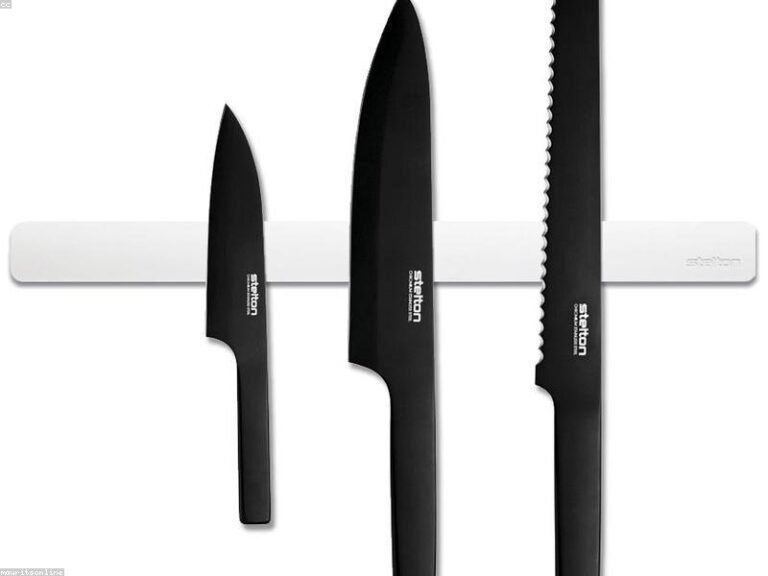
If a knife description uses the word “tactical” more than once, it’s trying to distract you from mediocre specs. A black-coated blade isn’t tactical — it’s just black. A tanto point isn’t tactical — it’s harder to sharpen. The most “tactical” thing you can do with a knife is not need to use it.
The 30-Second Spec Sheet Scan
Next time you’re staring at a knife listing, run this mental checklist:
- Steel type? If it just says “stainless steel” with no grade, it’s an unknown budget steel. Skip.
- HRC range? If listed and it’s below 56 or above 63, there’s a reason (either cheap or brittle). 58–61 is the Goldilocks zone.
- Grind type? Full-flat or hollow = good slicing. Scandi = woodwork. Saber = hard-use but wedges.
- Weight? Under 4 oz = you’ll actually carry it. Over 5 oz = it’ll live in a drawer.
- Lock mechanism? All modern locks are safe if the manufacturer is reputable. Avoid no-name liner locks on sub-$20 knives — those are the ones that fail.
- Price? Compare the steel grade to the price tier above. If they’re charging S30V money for 8Cr13MoV, you’re paying for a brand logo.
FAQ — Spec Sheet Questions
Is D2 steel good? I keep seeing it everywhere.
D2 is the Toyota Camry of knife steels — reliable, capable, and incredible value. It’s technically a tool steel (not stainless), with 12% chromium content that’s just below the 13% threshold to be called “stainless.” In practice: it’ll spot-rust if you leave it wet or sweaty. Keep it dry, and D2 holds an edge better than most steels under $100. Civivi’s D2 heat treatment is particularly well-regarded.
What’s the difference between S30V and S45VN?
S45VN is the evolution of S30V (with S35VN in between). Additions of niobium and nitrogen give S45VN finer grain structure, meaning slightly better edge retention and toughness at the same hardness. For the average user: the difference is marginal. If you find a Para 3 in S45VN for the same price as S30V, take the S45VN. If S30V is cheaper, don’t lose sleep over it.
Does a higher HRC mean a better knife?
No — a higher HRC means a harder knife, not necessarily a better one. Above 62 HRC, blades become brittle and prone to chipping under lateral stress (twisting, prying). Below 56 HRC, they dull quickly. The ideal HRC for the steel depends on the intended use. Benchmade deliberately runs their S30V at 58–60 HRC instead of 60–61 because they prioritize toughness over absolute edge retention for EDC use. That’s a choice, not a flaw.
Why are powder metallurgy steels more expensive?
The CPM process requires atomization chambers, hot isostatic pressing, and significantly more quality control than conventional ingot casting. The result is a dramatically more uniform carbide structure, which translates to real-world performance gains — but the manufacturing cost is 3–5× higher. Whether that’s worth it depends on whether you’re cutting cardboard or collecting.
Bottom Line
The spec sheet tells a story — you just need to know how to read it. A Spyderco Para 3 listing that says “S45VN, 60–62 HRC, full-flat grind, G-10 handles, Compression Lock, 3.4 oz, USA-made” tells you everything you need to know: this is a top-tier production EDC knife engineered for slicing, with premium materials and a lock mechanism that’s the best in the business.
A listing that says “Premium Stainless Steel Blade, 3.5 inches, black tactical finish” and refuses to name the steel? That’s a $15 knife with a $40 price tag and a marketing department.
Learn the language. It pays for itself on the first purchase.
Disclosure: As an Amazon Associate, bladeowl.com earns from qualifying purchases. All product links use the bladeowl-20 affiliate tag.