
How to Buy Your First Quality Pocket Knife: A Complete Beginner’s Guide
Buying your first real pocket knife is overwhelming. BladeHQ lists thousands of knives. Reddit threads recommend everything from $30 budget blades to $400 customs. YouTube reviewers speak a language of “detent tuning” and “lock bar access” that means nothing to a newcomer. This guide strips away the jargon and gives you a clear path to your first quality knife.
Step 1: Define Your Use Case
Before looking at a single knife, answer this question honestly: What will you actually use this knife for? Be specific. “Everyday carry” means different things to different people. Opening Amazon packages at a desk job is not the same as breaking down cardboard in a warehouse is not the same as field-dressing game on a hunting trip.
Your use case determines everything else: blade length, steel type, lock mechanism, handle material, and budget. A $400 titanium framelock in M390 is the wrong knife for someone who will lose it in a warehouse. A $30 liner lock in 8Cr13MoV is the wrong knife for someone who will use it daily for a decade. Match the tool to the task.
Step 2: Choose Your Blade Length
Blade length is the most practical starting point because it immediately eliminates 80% of the market. Here is a rough guide:
- 2.5 – 3.0 inches: Office-friendly, legal in most jurisdictions. Fits easily in dress pants. Ideal for opening packages, cutting tags, light food prep. Examples: Spyderco Dragonfly, CRKT Piet, Civivi Baby Banter.
- 3.0 – 3.5 inches: The sweet spot for general EDC. Enough blade for serious cutting tasks, still pocketable. This is where most popular knives live. Examples: Spyderco Para 3, Benchmade Bugout, Ontario Rat 2.
- 3.5 – 4.0 inches: Full-size work knives. Better leverage for heavy cutting but larger in the pocket. Examples: Spyderco Paramilitary 2, Benchmade Griptilian, Cold Steel Recon 1.
Step 3: Understand Lock Mechanisms
The lock keeps the blade from closing on your fingers. All modern locks from reputable manufacturers are safe when used correctly. The differences are in ergonomics, ambidexterity, and fidget factor.
- Liner Lock: Most common. A spring-loaded metal liner wedges against the blade tang. Simple, reliable, typically right-handed. Found on most budget to mid-range knives.
- Frame Lock: Same mechanism as a liner lock but the frame itself is the lock bar (usually titanium). Stronger than a liner lock, often on premium knives. Chris Reeve popularized this.
- Axis / Crossbar Lock: Benchmade’s signature. A spring-loaded bar slides across the tang. Fully ambidextrous, very strong, very fidget-friendly. The patent expired so many brands now use it.
- Button Lock: A spring-loaded button locks the blade. Smooth action, ambidextrous, addictive to fidget with. Gaining popularity on mid-range knives.
- Back Lock: Traditional lockback mechanism. Strong, ambidextrous, but typically requires two hands to close. Spyderco executes this better than anyone.
For a first knife, a liner lock or crossbar lock is hard to beat. Both are safe, intuitive, and widely available at all price points.
Step 4: Choose Your Blade Steel
At the beginner level, do not overthink steel. The steel that comes on a reputable brand’s knife at your budget is almost certainly appropriate for that knife. That said, here is the simplified version:
- Under $50: D2 or 14C28N. Both are excellent. D2 holds an edge longer but can rust. 14C28N sharpens easily and is very stainless.
- $50-$100: 14C28N, Nitro-V, 154CM, VG-10. All are solid performers. You will notice the upgrade from gas-station mystery steel immediately.
- $100-$200: S30V, S35VN, SPY27 (Spyderco exclusive). Premium steels with noticeably better edge retention.
- $200+: M390, 20CV, MagnaCut. Super steels that hold an edge for months with proper use.
Step 5: Set a Budget and Stick to It
The knife market has excellent options at virtually every price point above $30. Below that, quality drops off sharply. Here are the tiers:
- $30-$50: The Value Tier. Ontario Rat 2, QSP Penguin, CJRB Feldspar. Genuinely good knives that will serve you well for years.
- $50-$100: The Sweet Spot. Civivi Elementum, Kershaw Leek, Spyderco Tenacious. Better fit and finish, more steel options, smoother action.
- $100-$200: Premium Production. Spyderco Para 3, Benchmade Bugout, Hogue Deka. American-made, premium steels, lifetime warranty.
- $200+: Enthusiast Territory. You are now buying for materials, action, and brand heritage rather than any practical improvement in cutting performance.
My recommendation for a first knife: spend $50-$100. The Civivi Elementum or Spyderco Tenacious represent the point where every additional dollar spent yields noticeable quality improvements. Below $30, you compromise on steel and build quality. Above $100, you enter diminishing returns territory as a beginner.
Step 6: Decide on Deployment
- Thumb Stud: Simple, reliable. Requires thumb dexterity. The most common opening method.
- Flipper Tab: A tab on the back of the blade that you push with your index finger. Satisfying “snap” when the blade locks open. Requires a detent-based mechanism.
- Thumb Hole: Spyderco’s signature. A round hole in the blade allows opening with thumb or middle finger. Works with gloves. Looks weird until you use it, then it makes perfect sense.
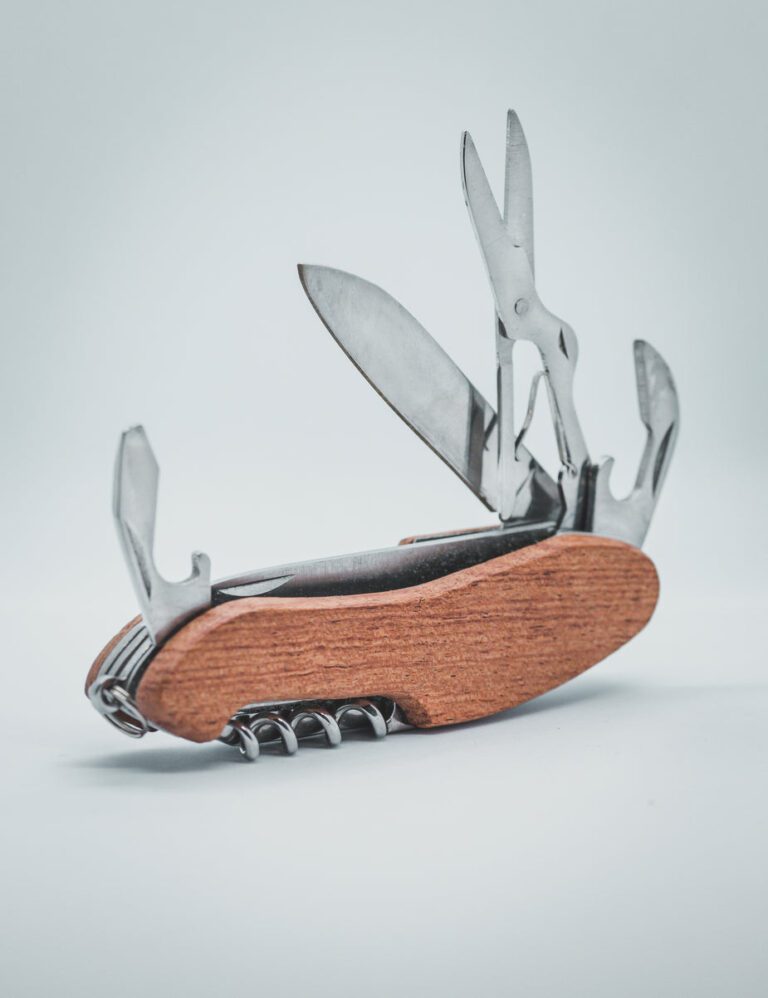
- Nail Nick: Traditional two-hand opening. Found on slipjoints and Swiss Army Knives. Slow but socially non-threatening.
For a first modern folding knife, a flipper or thumb stud is the most intuitive.
Step 7: Handle Material and Ergonomics
The handle determines how the knife feels in your hand during use. This is subjective and hand-size dependent. If possible, handle knives in person before buying. If not, read reviews focusing on ergonomics for your hand size.
- G-10: Fiberglass laminate. Grippy, durable, weather-resistant. Industry standard on quality knives.
- FRN (Fiberglass Reinforced Nylon): Lighter, cheaper, slightly less premium feel. Spyderco’s FRN is excellent.
- Micarta: Fabric or paper in resin. Develops character over time, excellent grip when wet. Popular on traditional and premium knives.
- Titanium: Premium, durable, can be anodized. Usually found on frame lock knives above $150.
- Wood: Beautiful, traditional. Requires more care. Found on traditional patterns and some modern knives.
Recommended First Knives
Budget ($30-50): Ontario Rat 2 in D2. The universal recommendation for a reason.
Mid-Range ($50-80): Civivi Elementum. The knife that redefined the $50 price point.
Premium ($100-180): Spyderco Para 3. American-made, S45VN steel, compression lock. A knife you will never outgrow.
Ultralight ($150-180): Benchmade Bugout. 1.85 ounces. Disappears in the pocket. The quintessential modern EDC.
Buy one of these four knives. Use it. Learn what you like and dislike about it. Your second knife purchase will be informed by actual experience rather than Reddit opinions, and that makes all the difference.
Disclosure: BladeOwl participates in the Amazon Services LLC Associates Program. As an Amazon Associate, we earn from qualifying purchases at no additional cost to you.