Chef Knife vs Santoku — Which One Actually Belongs in Your Kitchen?
This article contains affiliate links. As an Amazon Associate, we earn from qualifying purchases.
Here’s the scene: you’re standing in a kitchen store, one knife in each hand. In your left, a classic 8-inch chef’s knife — curved belly, pointed tip, heavy. In your right, a 7-inch Santoku — flat edge, sheepsfoot tip, noticeably lighter. The salesperson is watching. Your phone is dying. And you have absolutely no idea which one to buy.
You’re not alone. This is the single most common knife dilemma in home cooking. And the internet is absolutely no help — half the articles say “get a chef’s knife, it does everything,” the other half insist “Santoku is the future, chef’s knives are obsolete.” Both camps are wrong.
The real answer? It depends entirely on how you cook. Let’s settle this properly.
Chef Knife vs Santoku: The Quick Comparison
| Feature | Chef’s Knife | Santoku |
|---|---|---|
| Origin | Germany/France (Western) | Japan (Eastern) |
| Blade Length | 6-10 inches (8 standard) | 5-7 inches (7 standard) |
| Blade Shape | Curved belly, pointed tip | Flat edge, sheepfoot tip |
| Cutting Motion | Rocking chop (tip stays on board) | Push cut / up-and-down chop |
| Weight | Heavier (8-10 oz typical) | Lighter (5-8 oz typical) |
| Best For | All-purpose, meat, large veg | Vegetables, precision work |
| Steel Type | Typically softer German steel (HRC 56-58) | Harder Japanese or German (HRC 58-63) |
| Price Range | $30-$200+ | $30-$350+ |
The Real Differences (That Actually Matter)
1. Blade Shape Changes Everything
This is where things get interesting — because Santokus are made in both traditions.
German steel (used in Wusthof, Zwilling, and Mercer knives) is softer at HRC 56-58. It’s tougher, more forgiving, and resists chipping. You can hit a chicken bone and the edge might roll slightly but it won’t crack. Sharpening is straightforward — a few passes on a honing steel or stone and you’re back in business. The trade-off? You’ll need to maintain it more frequently.
Japanese steel (used in Global, Shun, Miyabi, and MAC knives) is harder at HRC 58-63. It holds an edge dramatically longer — the SG2 steel in the Miyabi Birchwood can go months between sharpenings. But hard steel is more brittle. Use a Japanese Santoku on frozen food, bones, or hard-shell squash, and you risk chipping the blade. Sharpening also requires more skill — these fine edges demand proper whetstone technique.
The key insight: A German-made Santoku (like the Wusthof) gives you the Santoku shape with German durability. A Japanese chef’s knife gives you the chef’s knife shape with Japanese sharpness. Don’t assume “Santoku = Japanese steel” or “chef’s knife = German steel.”
4. The Tip (Literally)
Chef’s knives have a sharp, pointed tip designed for precision work — trimming silver skin from meat, scoring bread, hulling strawberries, or making delicate incisions. This pointed tip is one of the chef’s knife’s biggest advantages for protein work.
Santokus have a sheepsfoot tip — it drops down bluntly toward the spine. This makes the knife safer (no accidental pokes) but less useful for detail work that requires a sharp point. For breaking down a whole chicken or trimming a brisket, the chef’s knife wins easily.



Head-to-Head: Our Top Picks in Each Category
| Knife | Type | Steel | HRC | Weight | Price |
|---|---|---|---|---|---|
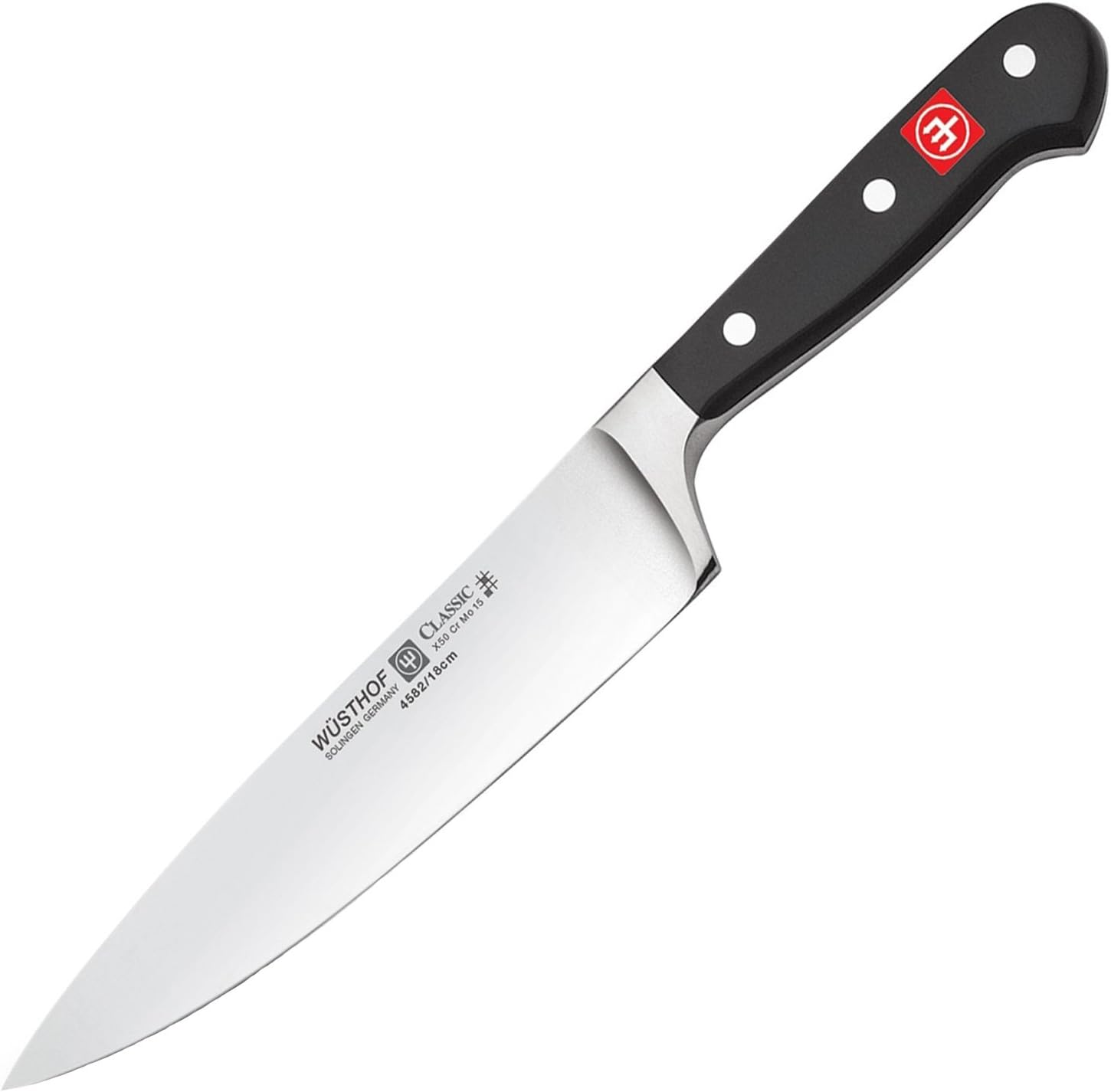
| Wusthof Classic 8 Chef | Chef’s Knife | German X50CrMoV15 | 58 | 8.5 oz | ~$170 |
| Wusthof Classic 7 Chef | Chef’s Knife | German X50CrMoV15 | 58 | 6.7 oz | ~$150 |
| Wusthof Classic 7 Santoku | Santoku | German X50CrMoV15 | 58 | 8.5 oz | ~$130 |
| Wusthof Classic Ikon 7 Santoku | Santoku | German X50CrMoV15 | 58 | 7.1 oz | ~$170 |
| Global G-80 7 Santoku | Santoku | CROMOVA 18 | 56-58 | 6.6 oz | ~$110 |
Which Knife for Which Job?
Vegetable Prep
Winner: Santoku. The flat edge makes full board contact, delivering more consistent slices. The lighter weight reduces fatigue during marathon veg prep. The granton edge (on most Santokus) helps wet vegetables release from the blade. If you cook primarily plant-based meals, you want a Santoku.
Meat and Protein
Winner: Chef’s knife. The pointed tip is essential for trimming fat and silver skin. The curved belly lets you slice through large cuts of meat in one smooth draw. The extra weight helps power through dense proteins. While a Santoku can handle boneless chicken breasts and fish fillets just fine, the chef’s knife is simply more versatile here.
Herbs and Garlic
Winner: Santoku. The flat blade is ideal for the up-and-down mincing motion. The lighter weight gives you more control when you’re doing fine chiffonade. If you’ve ever tried to mince parsley with a heavy chef’s knife, you know how quickly your wrist complains.
Large Ingredients (Squash, Cabbage, Watermelon)
Winner: Chef’s knife. The extra length (8 inches vs 7) means fewer strokes to get through large ingredients. The weight helps power through dense squash. The pointed tip lets you start cuts precisely. A 7-inch Santoku can handle these tasks, but it’ll require more passes.
Precision Work (Garnishes, Deveining, Scoring)
Winner: Chef’s knife. That pointed tip is invaluable for detail work. Trying to devein shrimp or score bread dough with a sheepsfoot tip is like painting with a flathead screwdriver — possible, but why would you?
Do You Actually Need Both?
The honest answer for most home cooks: no. You don’t need both. You need one good knife that matches your cooking style.
If you primarily rock-chop, cook a lot of meat, and want one knife that does everything from breaking down a chicken to mincing garlic — get an 8-inch chef’s knife. The Wusthof Classic 8-Inch Chef’s Knife is our top recommendation. It’s the knife most professional chefs reach for, and for good reason. It will handle 95% of your kitchen tasks without complaint.
If you naturally push-cut, cook mostly vegetables, and value lightness and precision over brute versatility — get a 7-inch Santoku. The Wusthof Classic Ikon 7-Inch Santoku gives you the best of both worlds: German durability with Japanese-style geometry.
If you have the budget and counter space, having both is genuinely nice. The chef’s knife becomes your heavy-duty daily driver, and the Santoku lives on the board for vegetable work. But if you’re building your first proper knife setup, start with one and add the other later.
👉 Wusthof Classic 7-Inch Santoku on Amazon
The Steel Question: German vs Japanese
Here’s a shortcut that’ll save you hours of research:
Get German steel if: You’re hard on your knives. You want something forgiving that won’t chip. You don’t mind honing regularly. You use the same knife for everything including cutting around bones. You want a lower-maintenance relationship with your tools.
Get Japanese steel if: You’re careful with your tools. You value maximum sharpness. You’re willing to learn whetstone sharpening or pay for professional sharpening. You want the edge to last as long as possible between maintenance. You enjoy the ritual and craftsmanship.
The Wusthof knives on this page use German steel at HRC 58 — durable, forgiving, and easy to maintain. The Global G-80 Santoku uses Japanese CROMOVA 18 steel and gives you a taste of the Japanese experience at a reasonable price.
One Final Variable: Your Cutting Board
Nobody talks about this, but it matters: your cutting board should dictate your blade length. A Santoku’s blade should fit within about two-thirds of your board’s width. If you’re working on a standard 14-inch board, a 7-inch Santoku fits beautifully. On a tiny apartment board, even a 7-inch knife can feel oversized.
The same goes for chef’s knives. An 8-inch blade is standard, but if your primary cutting surface is 12 inches wide or less, consider a 7-inch chef’s knife instead. You’ll be surprised how much more comfortable a properly sized knife feels.
Conclusion: Here’s What to Do
If you walked into this article confused and want a clear answer, here it is:
Buy the Wusthof Classic 8-Inch Chef’s Knife if: You’re buying your first serious kitchen knife and want maximum versatility. It does everything well, from delicate herb work to breaking down chickens. It’s the safest recommendation in kitchen knives, period.
Buy the Wusthof Classic Ikon 7-Inch Santoku if: You’ve used chef’s knives before and found them too large or heavy. You cook primarily vegetables. You prefer a push-cut or up-and-down cutting motion. You want something lighter and more precise.
Buy both if: You cook seriously and frequently. You have the budget and the counter space. Use the chef’s knife for heavy lifting and protein work, the Santoku for vegetables and precision tasks.
Either way, you’re getting a tool that — with proper care — will outlast you. That’s the beauty of a great knife.
Frequently Asked Questions
Can I use a Santoku for everything a chef’s knife can do?
Almost everything. The Santoku handles vegetables, boneless meats, fish, and herbs beautifully. Where it falls short is tasks requiring a pointed tip (trimming silver skin, deveining shrimp, scoring bread) and large-scale cutting (whole squash, cabbages) where the extra inch on a chef’s knife makes a genuine difference. For 90% of home cooking tasks, a Santoku is more than sufficient.
Why are Santoku knives more popular now?
The Santoku’s rise in the West started with Rachael Ray championing them on her cooking show in the early 2000s, but the real driver is home cooking trends. As more people cook plant-forward meals at home, a lighter, vegetable-optimized knife makes more sense than a heavy German chef’s knife designed for butchering. The Santoku is also less intimidating for new cooks — it’s shorter, lighter, and feels more controllable.
What size chef’s knife should I get?
8 inches is the standard for good reason — it handles everything from a clove of garlic to a whole cabbage. If you have small hands, a small kitchen, or primarily cook for 1-2 people, a 7-inch chef’s knife might feel more comfortable. If you’re processing large quantities regularly, a 10-inch blade can save you serious time. But 8 inches is the safe, versatile default.
Is a Santoku easier to sharpen than a chef’s knife?
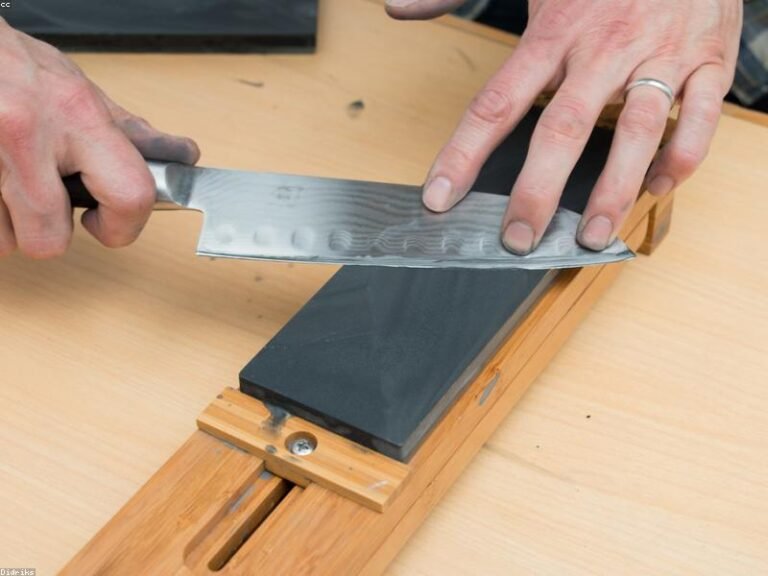
Generally, yes — but it depends on the steel, not the shape. The flatter Santoku profile is actually slightly easier to maintain on a whetstone because there’s less curvature to follow. However, a German-steel chef’s knife at HRC 58 is still easier to sharpen than a Japanese-steel Santoku at HRC 63. The steel matters more than the shape.
Can left-handed people use Santokus?
Most Western-style Santokus (Wusthof, Global, Mercer) have symmetrical handles and double-bevel edges, making them fully ambidextrous. Some traditional Japanese Santokus with D-shaped handles and single-bevel edges are right-handed only. Always check — especially with high-end Japanese brands like Miyabi and Shun.
How much should I spend on my first good knife?

For a knife you’ll use every day for decades, $100-$170 is the sweet spot. At this price, you get forged construction, quality steel, good balance, and a lifetime warranty. You can absolutely spend less (the Mercer Genesis Santoku at $35 is genuinely good) or more (the $340 Miyabi Birchwood is stunning), but $130-$170 gets you a knife you’ll never outgrow. That’s about $5 per year over 30 years. Worth it.
👉 Get the Wusthof Classic 8-Inch Chef’s Knife on Amazon | 👉 Get the Wusthof Classic 7-Inch Santoku on Amazon