The Complete Guide to Knife Sharpening Systems: Stones, Guided Systems, and More
A sharp knife is essential for both cooking and everyday carry, but achieving a razor edge requires the right tools. The world of knife sharpening has evolved dramatically, offering solutions for every skill level and budget. From traditional whetstones to high-tech guided systems and electric sharpeners, this guide covers every major sharpening system to help you choose the right setup for your needs.
Understanding Sharpening Fundamentals
Before comparing systems, let us clarify what sharpening actually does. A knife edge under a microscope looks like a microscopic saw blade — tiny teeth that grip and cut material. As you use the knife, these teeth wear down, bend, and eventually break off. Sharpening removes metal to create a fresh edge with clean, well-aligned teeth.
The sharpest possible edge is achieved when two flat planes of steel meet at a precise angle with zero radius at the apex — theoretically a single atom wide. In practice, most sharpening aims for a burr-free edge at the intended angle, polished to the desired level of refinement.
Different sharpening systems approach this goal differently, each with trade-offs in speed, precision, ease of use, and cost.
Whetstone Sharpening
Whetstones (from the Old English word whet, meaning to sharpen — not from water) are the traditional method and remain the gold standard for edge quality.
How Whetstones Work
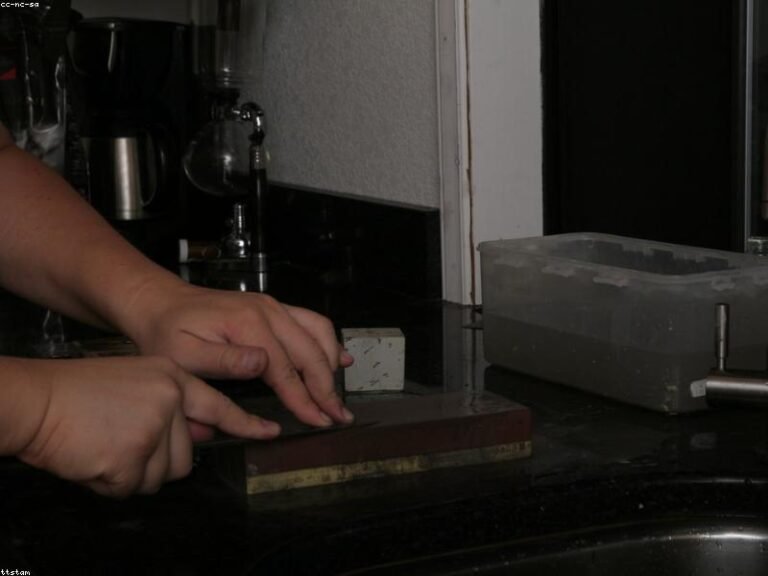
Whetstones use abrasive particles bonded together in a block. As you move the blade across the stone, the abrasive particles cut into the steel, removing material and shaping the edge. Water or oil lubricates the process, carrying away swarf (metal particles) and preventing the stone from clogging.
Types of Whetstones
Water Stones: The most common type today. Water stones cut quickly because the binder that holds the abrasive particles together breaks down during use, constantly exposing fresh abrasive. This is both a blessing (fast cutting) and a curse (stones dish — develop low spots — and need regular flattening).
Water stones range from extremely coarse (120 grit) for repairing damaged edges to ultra-fine (30,000 grit) for mirror polishing. A combination stone with 1000 and 6000 grit sides covers most sharpening needs.
Popular water stone brands include King (affordable classic), Shapton (premium splash-and-go), Naniwa (excellent feedback), and Suehiro (great value).
Oil Stones: The traditional Western sharpening stone, using oil as lubricant. Oil stones are harder than water stones and cut more slowly, but they stay flat longer. Arkansas stones are a subset of oil stones made from natural novaculite — extremely fine and prized for final edge refinement. Oil stones are less popular today for general sharpening but still valued by traditionalists.
Diamond Stones: Industrial diamonds bonded to a metal or plastic plate. Diamond stones cut any steel — including the hardest super-steels with high vanadium carbide content that ceramic stones struggle with. They stay perfectly flat and require only water as lubricant. The DMT and Atoma brands are the standard bearers.
Diamond stones are ideal for: sharpening high-carbide super-steels (M390, S90V, S110V), establishing new edge angles, flattening other whetstones, and heavy metal removal for repair work.
Ceramic Stones: Hard, slow-wearing stones that excel at fine edge refinement. Spyderco’s ceramic stones are the best-known examples. They do not require soaking and stay flat for a very long time. The hard surface provides less feedback than water stones but is virtually indestructible.
Find your starter whetstone: Beginner Whetstone Kit
Pros and Cons of Whetstones
Pros:
– Produce the highest quality edge when used skillfully
– Versatile — one stone set sharpens any knife
– No limits on blade length or shape
– Very satisfying skill to develop
– Lower long-term cost than guided systems
– Can create convex and compound bevels
Cons:
– Significant learning curve — expect mediocre results for the first several sessions
– Requires consistent angle control throughout each stroke
– Stones need flattening maintenance
– Messy — water and metal slurry get everywhere
– Slow compared to powered systems
– Frustrating for super-steels without diamond stones
Best for: Enthusiasts who want the highest possible edge quality, enjoy hands-on skills, and are willing to invest time in learning.
Guided Sharpening Systems
Guided systems address the primary challenge of freehand sharpening — maintaining a consistent angle — by mechanically fixing the relationship between the blade and the abrasive.
How Guided Systems Work
The knife is clamped into a holder, and sharpening stones are attached to a guide rod that pivots from a fixed point. The guide rod ensures the stone hits the edge at the same angle every stroke. You move the stone across the edge while the system maintains the angle. Flip the knife or the clamp to work the other side.
Popular Guided Systems
Work Sharp Precision Adjust: The value leader in guided systems. A simple clamp holds the knife, and a guide rod with small diamond stones does the work. Available in standard (three grits, manual angle adjustment) and Elite (seven grits, digital angle indicator) versions. Produces excellent results with minimal skill at a very affordable price point. The main limitation is that the clamp is somewhat small for very large knives.
Lansky System: The classic entry-level guided system that has been teaching people to sharpen for decades. Uses a clamp and guide rods with pre-set angle holes (17, 20, 25, and 30 degrees). Simple, effective, and very affordable. The stone selection is limited compared to premium systems, and the set angles may not match your desired angle exactly.
KME Precision Sharpener: A significant step up in quality and price. The KME uses a spherical bearing rod guide for smooth, wobble-free operation. The clamp rotates to work both sides without removing the knife. Supports a wide range of KME-branded stones including diamond and lapping films for mirror edges. A spacer system allows precise angle setting.
Wicked Edge: The ultimate guided system with a price tag to match. The Wicked Edge clamps the knife vertically and uses dual guide rods so you sharpen both sides simultaneously. This eliminates the need to flip the knife and ensures perfectly symmetrical bevels. The precision is extraordinary — capable of creating perfectly mirrored edges at precisely controlled angles. The base model starts around $300 and pro systems exceed $1000.
TSProf: A Russian-designed system gaining popularity for its heavy-duty construction and precision. The clamp rotates 360 degrees, and the system accommodates very large knives. Compatible with a wide range of third-party stones.
Pros and Cons of Guided Systems
Pros:
– Perfect angle consistency every time
– Minimal skill required — results in your first session
– Repeatable — the same sharpening every time
– Excellent for premium knives where mistakes are costly
– Many systems support lapping films and strops for mirror polishing
Cons:
– More expensive entry cost than basic whetstones
– Setup and takedown time per knife
– Limited to certain blade lengths by clamp size
– Less versatile than whetstones for unusual blade shapes
– Can be slower than freehand for experienced users
– Less satisfying for those who enjoy the craft
Best for: Beginners who want guaranteed results, collectors with expensive knives to maintain, and anyone who values consistency over the craft of freehand sharpening.
Explore guided systems: Knife Sharpening Systems
Electric Sharpeners
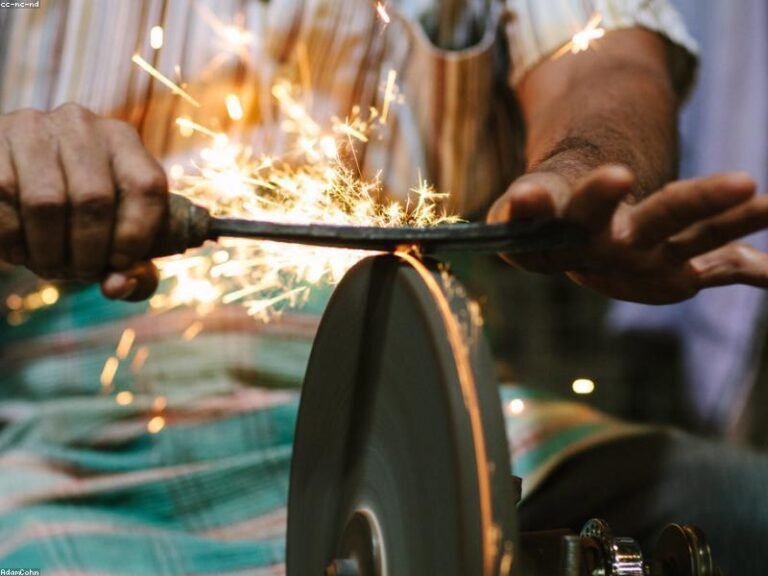
Electric sharpeners use motorized abrasive wheels or belts to sharpen knives quickly with minimal user input. They are the fastest method but also the most aggressive.
Types of Electric Sharpeners
Slot-Style Electric Sharpeners: The most common type, recognizable by the slots you pull the blade through. Motorized abrasive wheels spin inside, and angled guides set the sharpening angle. Multiple slots provide different grits — typically coarse for damaged edges and fine for finishing.
The Work Sharp Culinary E5 and Chef’sChoice models dominate this category. These are designed for kitchen knives and produce acceptable results on softer steels.
Belt Grinders: The Work Sharp Ken Onion Edition uses a flexible abrasive belt running over a curved platen, allowing you to sharpen any blade shape including curved and recurve blades. The belt speed is variable, and the system includes angle guides. It is significantly more versatile than slot-style electric sharpeners and can produce excellent edges on everything from kitchen knives to axes.
Pros:
– Extremely fast — sharpen a completely dull knife in under a minute
– Minimal skill required
– Good for high-volume sharpening (restaurants, processing facilities)
– Belt systems handle any blade shape
Cons:
– Aggressive material removal — easy to remove more metal than intended
– Can overheat the edge, affecting heat treatment
– Less precise than guided systems
– Risk of ruining expensive knives with one bad pass
– Most cannot achieve extreme sharpness
– Not suitable for Japanese knives with thin, hard edges
Best for: Inexpensive kitchen knives, high-volume sharpening, and users who prioritize speed over edge quality. Not recommended for premium knives or EDC blades.
Pull-Through Sharpeners
The simplest and most affordable option: a V-shaped slot with carbide cutting blades or ceramic rods. Pull the knife through, and the sharpener removes metal from both sides simultaneously.
Pros:
– Inexpensive (typically $5-20)
– Instant results
– No skill required
– Compact storage
Cons:
– Fixed angle that may not match your knife
– Carbide versions are extremely aggressive — they rip metal away rather than cut cleanly
– Creates a rough, toothy edge that dulls quickly
– Cannot produce a truly sharp edge by enthusiast standards
– Wavy, uneven edges from inconsistent pull pressure
– Cannot sharpen the full blade length due to the bolster on forged knives
Best for: Beater knives, garden tools, and situations where any edge — even a rough one — is better than no edge. Not recommended for any knife you value.
Honing Rods and Steels
A honing rod (often called a sharpening steel, though it does not sharpen) realigns the microscopic edge between sharpenings. It is a maintenance tool, not a sharpening tool.
Steel Rods: Traditional grooved steel rods. Work well on softer German-style knives (56-58 HRC). The grooves are aggressive for a honing tool and can micro-chip hard Japanese edges. Not recommended for knives above 60 HRC.
Ceramic Rods: Harder than any steel, ceramic rods can micro-sharpen rather than just realign. They remove a tiny amount of metal while honing. Suitable for all knife steels including hard Japanese blades. The surface can load with metal and needs occasional cleaning.
Diamond Rods: Diamond-coated steel rods that remove metal aggressively. Used more for edge touch-ups than pure honing. The coarse surface can leave a toothy edge that some users prefer for kitchen work.
Proper honing technique: Hold the rod vertically with the tip on a cutting board. Place the heel of the blade against the rod at your sharpening angle. Draw the blade down and across, maintaining the angle. Alternate sides with light pressure. Five to seven passes per side are usually sufficient before a cooking session.
Stropping
A leather strop loaded with polishing compound is the final step in achieving a razor edge. Stropping removes the microscopic burr that remains after sharpening and polishes the edge to a mirror finish.
Strops can be:
– Hanging strops: Leather suspended between two points, like a traditional barber strop
– Paddle strops: Leather glued to a flat wooden paddle, easier to control
– Bench strops: Leather on a flat rigid base, for use on a table
Stropping compounds range from coarse (black) to ultra-fine (white, green, and sub-micron diamond sprays). Green chromium oxide compound is the most popular all-purpose choice.
Stropping is also an excellent maintenance technique — a few passes on a strop before each use keeps a knife sharp much longer between full sharpenings.
How to Choose Your Sharpening Setup
For the Beginner
Start with a guided system like the Work Sharp Precision Adjust. It produces excellent results immediately, teaches you what a sharp edge feels like, and builds confidence. Add a ceramic honing rod for kitchen knives and a strop for final edge refinement.
For the Enthusiast
Invest in a set of quality whetstones — a 400/1000 diamond stone for heavy work, a 1000/6000 water stone for refinement, and a flattening plate. Add a leather strop with compound. The learning curve is real, but the skill is deeply satisfying and the results are unmatched.
For High-Volume Sharpening
An electric belt system like the Work Sharp Ken Onion with the Blade Grinding Attachment provides speed and versatility. Supplement with a ceramic honing rod for daily maintenance between sharpenings.
For the Minimalist
A quality combination diamond stone (325/1200 grit) handles everything from repair to refinement without needing flattening or soaking. Add a pocket-sized ceramic rod for touch-ups. This two-tool setup keeps any knife sharp with minimal investment.
Build your sharpening setup: Complete Sharpening Kits
This article may contain affiliate links. If you purchase a product through one of these links, Bladeowl may earn a commission at no extra cost to you. This never influences our editorial independence or which products we recommend.