Best Bushcraft Knives for Beginners (2026)
Bushcraft is built on doing more with less, and no piece of gear matters more to that philosophy than the knife on your belt. For someone just starting out, the number of options on the market can be overwhelming, but the fundamentals of a good beginner bushcraft knife are well established. Here’s what actually matters.
Blade Length: The 4-5 Inch Sweet Spot
It’s tempting to think bigger is better when you’re heading into the woods, but most experienced bushcrafters settle on a blade somewhere between 4 and 5 inches. That length is long enough to baton through modest firewood or process game, yet short enough to retain the fine control you need for detail carving, notching, and trap or shelter work. A blade much longer than that becomes a chore to control for precision tasks, while anything under 3.5 inches struggles with batoning and heavier chores. A mid-size fixed blade will outperform an oversized “survival knife” for real bushcraft work.
Full Tang Construction Is Non-Negotiable
A full tang knife has a single piece of steel running the entire length of the handle, sandwiched between two handle scales. This is the standard for bushcraft because it gives the blade the strength to handle batoning and prying-adjacent tasks without flexing or snapping at the tang. Partial tang or “hidden tang” knives, where a thin rod of steel is buried inside a separate handle, are more prone to failure under lateral stress — exactly the stress you generate splitting wood with a baton. For a beginner, full tang construction also means one less thing to worry about breaking while you’re still learning what your knife can and can’t do.
Scandi Grind vs. Flat Grind
Grind geometry shapes how a blade behaves on wood. A scandi grind — a single flat bevel running from the spine to the edge with no secondary bevel — is a favorite among traditional bushcrafters because the flat surface acts as its own sharpening guide: lay the bevel flat on a stone and you’re automatically at the correct angle, which makes field sharpening far more forgiving for a beginner. Scandi grinds also excel at controlled wood removal for feather sticks and notching. A flat grind, by contrast, tapers from a thicker spine to the edge in one continuous slope, giving better all-around cutting performance and a stronger edge for food prep, but it demands more sharpening know-how since there’s no built-in angle reference. Neither is objectively better — scandi rewards wood work, flat grind rewards versatility.
Why Fixed Blades Beat Folders for Beginners
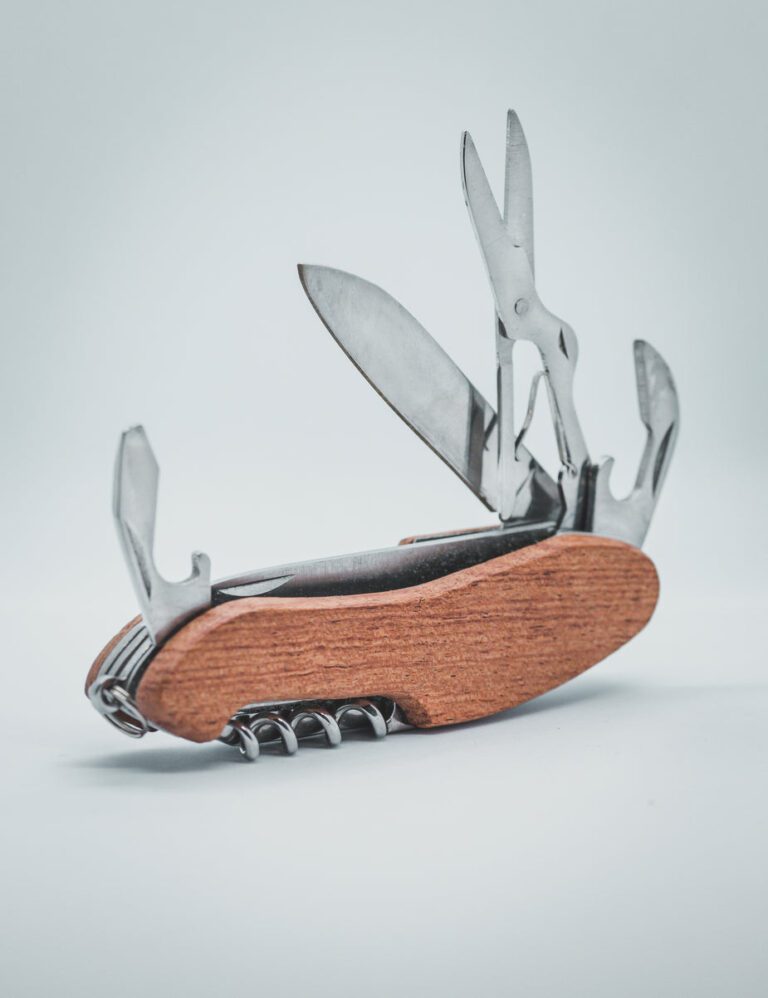
Folding knives have their place in an EDC rotation, but for bushcraft, a simple fixed blade is the smarter starting point. There’s no lock to fail under batoning stress, no pivot to loosen or collect debris, and no hinge point to weaken the structure. A fixed blade is also easier to keep clean in the field — fewer nooks for sap, dirt, and moisture to hide in. Simplicity is a feature here, not a limitation: fewer moving parts means fewer ways for things to go wrong.
Steel Choice: Carbon vs. Stainless
This is the classic bushcraft debate, and both sides have merit. Carbon steel blades, common in beginner-friendly bushcraft knives, are prized because they’re easy to bring back to a working edge with basic field tools like a puck stone, and they take a keener edge for fine carving. The tradeoff is that carbon steel will rust and patina if you don’t wipe it down and keep a light coat of oil on it, especially in humid conditions. Stainless steel trades a bit of that edge-sharpening ease for dramatically lower maintenance — it shrugs off moisture and neglect far better, which appeals to beginners who haven’t built a cleaning habit yet. Neither choice is wrong: if you want to learn traditional sharpening skills, go carbon; if you’d rather spend less time babying your blade, stainless is more forgiving.
Putting It Together
A great first bushcraft knife is rarely the flashiest one on the shelf. Look for a full tang, fixed blade with a 4-5 inch blade, a grind that matches your intended use, and a steel you’re willing to maintain. Master that combination before chasing exotic upgrades — the fundamentals will serve you long after the excitement of a new purchase wears off.
Beginner-Friendly Bushcraft Knives Compared
| Knife | Steel / Grind | Price Tier | Best For |
|---|---|---|---|
| Morakniv Companion | Carbon or stainless, scandi | Budget ($15-25) | The cheapest way to try scandi-grind carbon steel and learn field sharpening |
| Morakniv Garberg | Stainless (14C28N), full tang, scandi | Mid ($90-110) | Beginners who want full-tang durability with low-maintenance stainless steel |
| Condor Bushlore | 1075 carbon, full tang, scandi | Budget-Mid ($45-60) | A traditional wood-handled full-tang knife at a reasonable price |
| ESEE-4 | 1095 carbon, full tang, flat grind | Mid ($130-150) | Beginners who want to buy one knife they’ll never outgrow, backed by ESEE’s warranty |
Check Morakniv Companion on Amazon · Check Morakniv Garberg on Amazon · Check Condor Bushlore on Amazon · Check ESEE-4 on Amazon
This article may contain affiliate links. If you purchase a product through one of these links, Bladeowl may earn a commission at no extra cost to you. This never influences our editorial independence or which products we recommend.