Whetstone Grit Progression Explained
The Grit Numbers Are Lying to You (Sort Of)
Walk into any knife forum and you’ll see someone proudly posting their grit progression: “I start at 400, then 1000, 3000, 6000, 8000, then strop on 0.5 micron diamond paste.” That’s six stages of sharpening before the knife even touches food. And for what? A mirror polish that disappears the moment you slice your first onion.
Whetstone grit progression is one of the most misunderstood topics in sharpening. The numbers are inconsistently applied across brands (a Shapton 1000 is not the same as a King 1000), and the diminishing returns after 3000 grit are steeper than most people realize. This guide cuts through the noise and explains which grits you actually need — and which ones are a waste of money for 95% of users.
Grit Scales: JIS, ANSI, and Why They’re Different
Before we dive into specific stones, you need to understand that not all grit ratings mean the same thing. Japanese water stones typically use the JIS (Japanese Industrial Standard) scale. American and European abrasives may use ANSI, FEPA-F, or FEPA-P scales — and they don’t line up neatly.
Here’s the practical reality: a JIS 1000-grit stone has particles roughly 14-16 microns in size. An ANSI 1000-grit abrasive runs closer to 18-20 microns. And the difference becomes more dramatic at higher grits — a JIS 8000 stone (about 1.2 microns) would be equivalent to roughly ANSI 3000-4000 grit. Shapton’s “Professional” series (also sold as “Kuromaku”) uses its own proprietary scale that’s somewhat coarser than JIS at the same number.
The takeaway: when choosing stones, compare by manufacturer and product line, not just by the number on the box. A Shapton Pro 1000 cuts like many competitors’ 800. A King 1000 is noticeably finer and softer. We’ll cover the specific performance of each stone below.
400 Grit — The Edge Repair Specialist
400-grit stones are not for routine sharpening. They’re for edge repair: chips, rolls, broken tips, and knives that haven’t seen a stone in years. A 400-grit stone will hog off metal fast — which is exactly what you want when you’re reshaping a damaged edge, but exactly what you don’t want for weekly maintenance.
If you only sharpen your own kitchen knives that see regular honing, you probably don’t need a 400-grit stone at all. If you sharpen other people’s knives, restore flea-market finds, or own hard-use outdoor knives, keep one in your arsenal. The Atoma 400 diamond plate is ideal here — it stays flat forever, cuts any steel including super-steels, and doubles as a flattening plate for your other stones. If you prefer traditional water stones, the Naniwa Professional 400 offers exceptional feedback and a creamy cutting feel.
1000 Grit — The Everyday Workhorse
A good 1000-grit stone is the most important sharpening tool you’ll ever own. It’s coarse enough to raise a burr on a dull knife in reasonable time, and fine enough to leave an edge that’s genuinely sharp — not just “sort of sharp” but “cleanly slices newsprint” sharp. For European kitchen knives with 58 HRC or lower hardness, 1000 grit is often a perfectly good stopping point.
The three most popular 1000-grit stones, and how they differ:
- Shapton Pro/Kuromaku 1000 (~$45): A hard, splash-and-go ceramic stone that cuts aggressively and dishes slowly. It’s the sharpener’s sharpener — fast, precise, minimal mess. The trade-off: less tactile feedback than softer stones. If you’re a beginner still learning angle control, the Shapton’s hardness can make it harder to feel when you’re on the bevel.
- King KW65 1000/6000 Combo (~$30): The classic budget recommendation. Softer than the Shapton, which means better tactile feedback but faster dishing (the stone wears unevenly). The included 6000 side is a nice bonus for polishing, though the stone quality on the fine side is mediocre. Needs soaking. Best for beginners on a budget.
- Suehiro Cerax 1000 (~$40): The sweet spot between the two. Softer and more communicative than Shapton, harder and faster-cutting than King. Excellent feedback, good slurry formation, and works well on a wide range of steels. If you can only buy one 1000-grit stone, this is our pick.
3000-4000 Grit — The Refinement Zone
This is where things get nuanced. A 3000-grit edge is noticeably sharper than 1000 grit, but whether you’ll feel the difference in the kitchen depends on what you’re cutting. For fish, soft vegetables, and precision work like sushi or garnishes, the refinement is noticeable and worthwhile. For breaking down chickens, chopping root vegetables, or cutting crusty bread, it’s overkill — the fine edge dulls back to “working sharp” within minutes anyway.
The practical rule: if your knives are 58+ HRC hardness, a 3000-4000 grit finish holds up well. If they’re softer German steel (56-57 HRC), stick with 1000-2000 grit for a toothier edge that lasts longer in real-world use. The Shapton Pro 5000 (despite the name, it behaves more like a 3000-4000 in cutting speed) is a popular mid-range refinement stone that bridges this gap well.
6000-8000 Grit — The Law of Diminishing Returns
Above 5000 grit, you’re polishing more than sharpening. An 8000-grit edge is stunning to look at — a perfect mirror bevel that reflects light like chrome. It will treetop arm hair, push-cut paper towels, and make you feel like a master bladesmith. It will also lose that ultra-refined edge within the first few minutes of actual kitchen use.
Who actually needs an 8000-grit stone? Traditional Japanese single-bevel knives (yanagiba, usuba, deba) used for precise slicing where edge refinement directly impacts food quality. Straight razors. Show pieces. For everyone else — including professional chefs — it’s an enjoyable luxury, not a practical necessity.
If you do want a polishing stone, the Naniwa Super Stone 8000 or the Shapton Pro 8000 are the go-to options. The Naniwa leaves a slightly more polished finish; the Shapton cuts a bit faster. Both cost over $80 — which is why we recommend buying the 1000 first, then 3000-4000, and only then deciding if you really want the polish stone.
The Minimalist Progression: What 90% of People Actually Need
If you’re trying to keep your kitchen knives sharp without becoming a sharpening hobbyist, here’s the truth: two stones cover 90% of use cases.
- Medium stone (800-1000 grit): Your daily driver. Raises a burr, sharpens efficiently, leaves a perfectly usable edge.
- Fine stone (3000-4000 grit): Optional refinement. Makes a noticeable difference on hard steel and precise cutting tasks.
That’s it. Add a 400-grit stone if you repair damaged knives. Add a leather strop with compound if you want to maintain edges between sharpenings (stropping is faster than stone work and dramatically extends time between full sharpenings). Skip the 6000, 8000, and 12000 stones until you know exactly why you need them.
Recommended Stone Combos by Budget
| Budget | Coarse | Medium | Fine | Total Cost |
|---|---|---|---|---|
| Under $40 | N/A | King KW65 1000/6000 | (included) | ~$30 |
| $80-120 | Atoma 400 | Suehiro Cerax 1000 | N/A | ~$100 |
| $150-200 | Atoma 400 | Shapton Pro 1000 | Shapton Pro 5000 | ~$170 |
One Last Thing: Flatten Your Stones
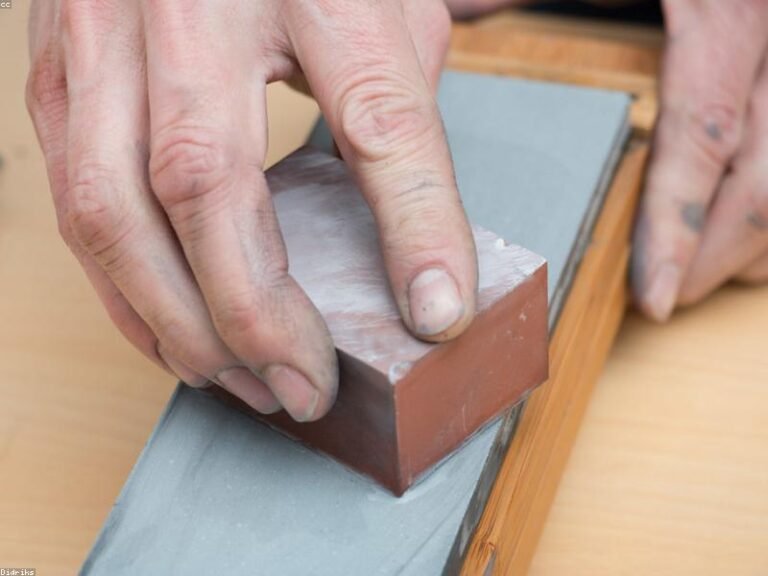
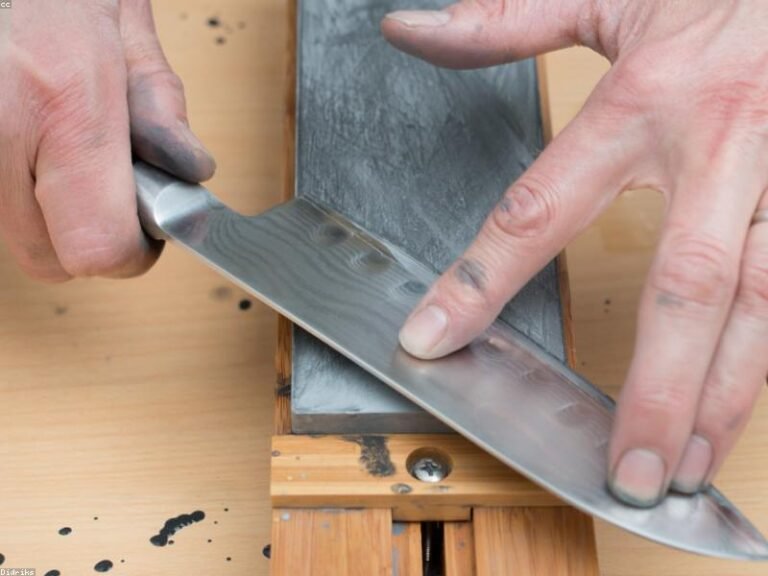
No matter which stones you buy, they will dish (wear unevenly) with use. A dished stone produces a convex edge that doesn’t make full contact with the blade. Flatten your stones regularly — every few sharpening sessions for soft stones like King, every 10-15 sessions for hard stones like Shapton. A diamond flattening plate like the Atoma 400 does double duty as a coarse stone and a flattening plate. Alternatively, wet/dry sandpaper on a flat surface (glass, granite offcut, or a certified-flat steel plate) works for budget-conscious sharpeners.
Flat stones, consistent angles, and a sensible grit progression: master these three things and your knives will always be sharper than 90% of the kitchens you walk into.
This article may contain affiliate links. If you purchase a product through one of these links, Bladeowl may earn a commission at no extra cost to you. This never influences our editorial independence or which products we recommend.