Best Kitchen Knife Sets Under $200 2026 — 3 Blocks That Actually Deliver Value
Kitchen knife sets are one of the easiest categories to get wrong. Big block sets look impressive on a counter, but most of what’s in them goes unused. Here’s what actually matters when picking a set that gives you real value instead of padded piece counts.
The Core Pieces You Actually Need
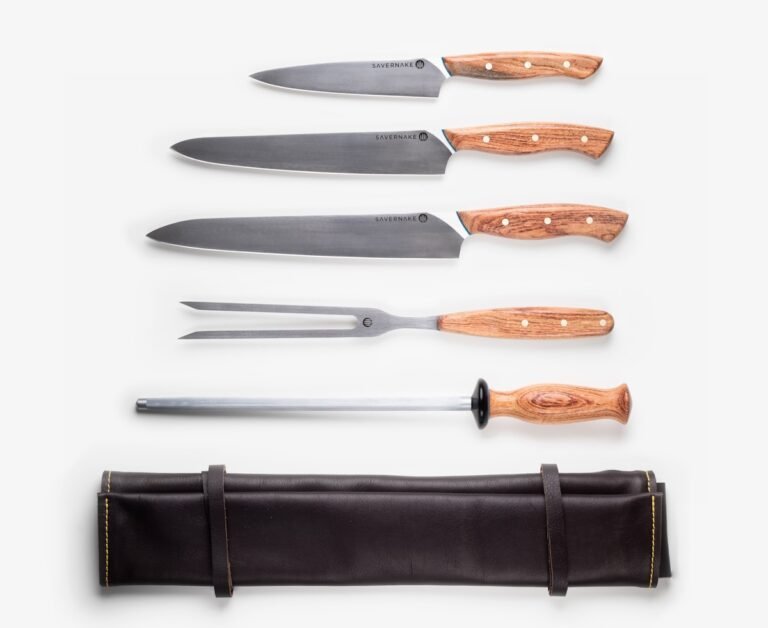
Almost everything you do in a kitchen can be handled by a small number of knives. A chef’s knife handles the majority of chopping, slicing, and dicing and should be the piece you judge a set by first. A paring knife covers small, precise tasks — peeling, trimming, hulling strawberries — where a large blade is unwieldy. A bread knife, with its serrated edge, is the only practical way to cut through a crusty loaf or a tomato’s skin without crushing it, since serrated edges saw rather than push through material. Beyond those three, a honing steel (technically a honing rod, not a sharpener) is essential for maintaining the edge between actual sharpenings — regular honing straightens a rolled edge and keeps the knife cutting well for much longer. That’s the real core of a useful set: chef’s knife, paring knife, bread knife, and a honing rod.
Block vs. Magnetic Strip Storage
Traditional wooden blocks are the default because they’re simple and keep blades protected, but they take up counter space and the slots are fixed to whatever knives came with the set, which can be awkward if you add or replace pieces later. Some blocks also hide moisture and crumbs in the slots if knives aren’t fully dry before storing.
A magnetic strip mounted on the wall keeps knives visible and easy to grab, dries them faster since they’re not sitting in a slot, and doesn’t force you into a fixed set of slots. The tradeoff is that blades are exposed rather than sheathed, which matters if you have small children or limited wall space near the kitchen. In-drawer knife trays are a middle ground — protected like a block, flexible like a strip, but they require drawer space to spare.
Forged vs. Stamped Blades
Forged knives are made by heating and hammering a single piece of steel into shape, which typically produces a thicker spine, a heavier balance, and often a full bolster where the blade meets the handle. Stamped knives are cut from a sheet of steel, similar to a cookie cutter, and are typically lighter and thinner. Forged knives are generally sturdier and considered higher quality, but a well-made stamped knife with decent steel can still perform very well and is often lighter and easier to handle for people who prefer a nimbler knife. Don’t assume “stamped” automatically means “bad” — plenty of respected knife lines are stamped, and plenty of mediocre knives are forged.
Avoiding Bloat Pieces
Large sets often pad their piece count with items that sound useful but rarely get used: multiple steak knives that most households already own separately, a santoku or utility knife that duplicates what your chef’s knife already does, kitchen shears that are usually flimsier than a standalone pair, and specialty blades like tomato or cheese knives that solve a problem most people don’t have. None of these are necessarily bad on their own, but paying for a dozen of them usually means the core three or four knives you’ll actually use every day are lower quality than if you’d bought fewer, better pieces.
3 Sets Under $200 Worth Considering
Applying the priorities above, here are three real sets that stay under $200 while avoiding the bloat-piece trap.
| Set | Price Tier | Key Differentiator | Best For |
|---|---|---|---|
| Zwilling J.A. Henckels Statement Knife Block Set | ~$130-160 | Forged German steel with a full bolster on the core pieces | Buyers who want forged quality without the Wusthof/Zwilling Pro price tag |
| Cuisinart Classic 15-Piece Knife Block Set | ~$60-80 | Stamped stainless blades, widest piece count for the money | Budget-conscious cooks who want a complete block with a chef’s, paring, and bread knife covered |
| Mercer Culinary Genesis 6-Piece Knife Block Set | ~$140-170 | Forged high-carbon German steel, NSF-certified, culinary-school pedigree | Cooks who want fewer, higher-quality pieces instead of a padded set |
What to Prioritize When Shopping
When comparing sets, look closely at the chef’s knife first since it’s the piece doing most of the work — check the steel type, the balance, and whether the handle feels comfortable, since specs on a box don’t tell you how a knife feels in hand. Then check whether the paring and bread knives are genuinely useful sizes rather than afterthoughts. A smaller set with three or four well-made knives and a proper storage solution will usually serve you better and longer than a large set stuffed with filler pieces.
This article may contain affiliate links. If you purchase a product through one of these links, Bladeowl may earn a commission at no extra cost to you. This never influences our editorial independence or which products we recommend.