Electric vs Manual Knife Sharpeners — Which One Saves Your Edge (and Your Time)?
You’re standing in your kitchen at 6:42 PM. Dinner needs to happen. Your chef’s knife mushes through an onion instead of slicing it. You grab that pull-through sharpener you bought at the grocery store three years ago, drag the blade through three times, and… it’s barely better. Maybe worse.
Sound familiar? The “electric vs. manual” debate isn’t just about convenience. It’s about edge geometry, steel removal rate, and whether your knives survive the process. Pick the wrong sharpener, and you’re doing more harm than good.
In this guide, I’ll break down exactly how electric and manual sharpeners compare — speed, edge quality, cost, ease of use, and which knives each one can handle. Then I’ll give you the top performers in each category so you can buy with confidence.
Electric vs. Manual Sharpeners: The Quick Comparison
| Feature | Electric Sharpeners | Manual Sharpeners |
|---|---|---|
| Speed | 30–60 seconds per knife | 2–10 minutes per knife |
| Edge Quality | Good to excellent (varies by model) | Excellent (with skill/practice) |
| Learning Curve | Nearly zero — press and pull | Moderate (angle control matters) |
| Cost Range | $35–$200+ | $8–$350+ |
| Steel Removal | Moderate to high (motorized abrasives) | Low to moderate (user-controlled) |
| Best For | Busy kitchens, multiple knives, speed | Precision, single-bevel, expensive blades |
| Worst For | Japanese single-bevel, serrated (most models) | Heavy repair, extreme dullness |
| Noise | Moderate to loud | Silent |
How Electric Knife Sharpeners Work
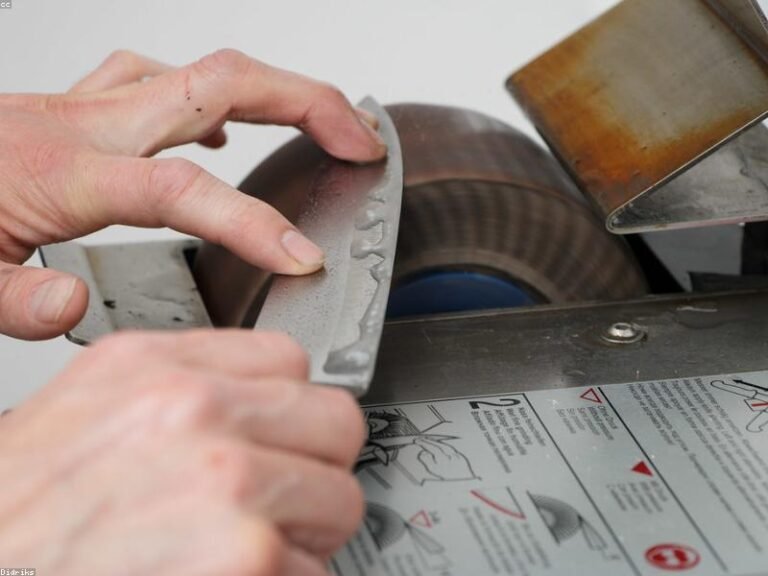
Electric sharpeners use motorized abrasive wheels — typically diamond-coated or ceramic — spinning at high RPM. You guide the knife through pre-set angled slots, and the wheels do the cutting. Most have 2–3 stages: coarse grinding, fine sharpening, and honing/polishing.
The key advantage? Consistency without skill. The slots hold the angle for you. Every pass is the same. You don’t need steady hands, you don’t need to know what 20 degrees feels like, and you don’t need 20 minutes of focused attention.
When Electric Sharpeners Excel
The Work Sharp Ken Onion Elite isn’t your typical sharpener — it’s a variable-speed belt grinder designed by legendary knife maker Ken Onion. If the Chef’sChoice is a precise instrument, the Work Sharp is a power tool for edges.
- Belt system: Interchangeable abrasive belts from coarse (P120) to ultra-fine (6000-grit equivalent)
- Adjustable angle: Guide adjusts from 15 to 30 — covers everything from Japanese gyutos to outdoor machetes
- Variable speed: Low for delicate edges, high for rapid stock removal
- Bonus: Also sharpens scissors, axes, lawn mower blades, and gardening tools
This thing is fast. You can restore a completely dull chef’s knife to hair-shaving sharp in under two minutes. The belt system means you can do everything from heavy repair (coarse belt) to mirror-polished convex edges (fine belt with stropping compound). It’s the most versatile sharpener on this list by a wide margin.
Pros: Extreme versatility, adjustable angle, variable speed, handles tools beyond knives. Cons: Steep learning curve, belts wear out and need replacing, can remove too much steel if you’re careless.
Presto EverSharp — Best Budget Electric

Not everyone needs a $165 diamond sharpener. The Presto EverSharp proves that $40 gets you a genuinely competent electric sharpener — as long as you’re working with Western-style knives.
- Three-stage system: Coarse grinding wheels, fine sharpening wheels, and stropping/polishing
- Sapphirite wheels: Proprietary abrasive — harder than ceramic, not as durable as diamond
- Fixed 20 angle: Works great for Henckels, Wüsthof, Victorinox, and most Western knives
- Blade guides: Magnetic guides hold the knife at the correct angle automatically
The EverSharp won’t give you a 15 Asian edge or handle specialty blades. But for the average kitchen — a block full of Zwilling, Cuisinart, and Farberware — it delivers noticeably sharper edges in under a minute. It’s the sharpener your parents should own.
Pros: Affordable, fast, simple, proven design (updated for years). Cons: Fixed angle only, wheels wear over time, not for Japanese knives.
Top Manual Knife Sharpeners for 2026
| Product | Type | Edge Angles | Best For | Price | Rating |
|---|---|---|---|---|---|
| Lansky Deluxe 5-Stone | Guided Rod System | 17, 20, 25, 30 | Best Precision Manual | ~$44.99 | 4.6 ⭐ |
| Spyderco Tri-Angle Sharpmaker | Crock Stick System | 30 (15 per side) & 40 (20 per side) | Fast Touch-Ups & Maintenance | ~$89.00 | 4.7 ⭐ |
Lansky Deluxe 5-Stone — Precision Without a Whetstone
If whetstones intimidate you but you still want whetstone-quality edges, the Lansky Deluxe 5-Stone is your answer. It’s a clamp-and-rod guided system that eliminates angle guesswork entirely.
- Five hones: Extra-coarse (70 grit), coarse (120), medium (280), fine (600), and ultra-fine (1000) aluminum oxide
- Four preset angles: 17, 20, 25, 30 — covers everything from kitchen knives to hunting blades
- Clamp system: Secures the knife so your angle never wavers between strokes
- Guide rods: Each hone attaches to a rod that rides in the angle slot — literally can’t get the wrong angle
The progression from 70 to 1000 grit gives you complete control over the edge. Start with the extra-coarse for repairs, work through the grits, and finish with the ultra-fine for a polished, razor-sharp bevel. It’s not fast — expect 10–15 minutes per knife — but the results rival stones you’d pay $100+ for.
Pros: Foolproof angle control, five-stone progression, affordable for the precision it delivers. Cons: Slow setup, clamp can mar softer blade finishes, not for very long knives (10+ blades are awkward).
Spyderco Tri-Angle Sharpmaker — The Maintenance King
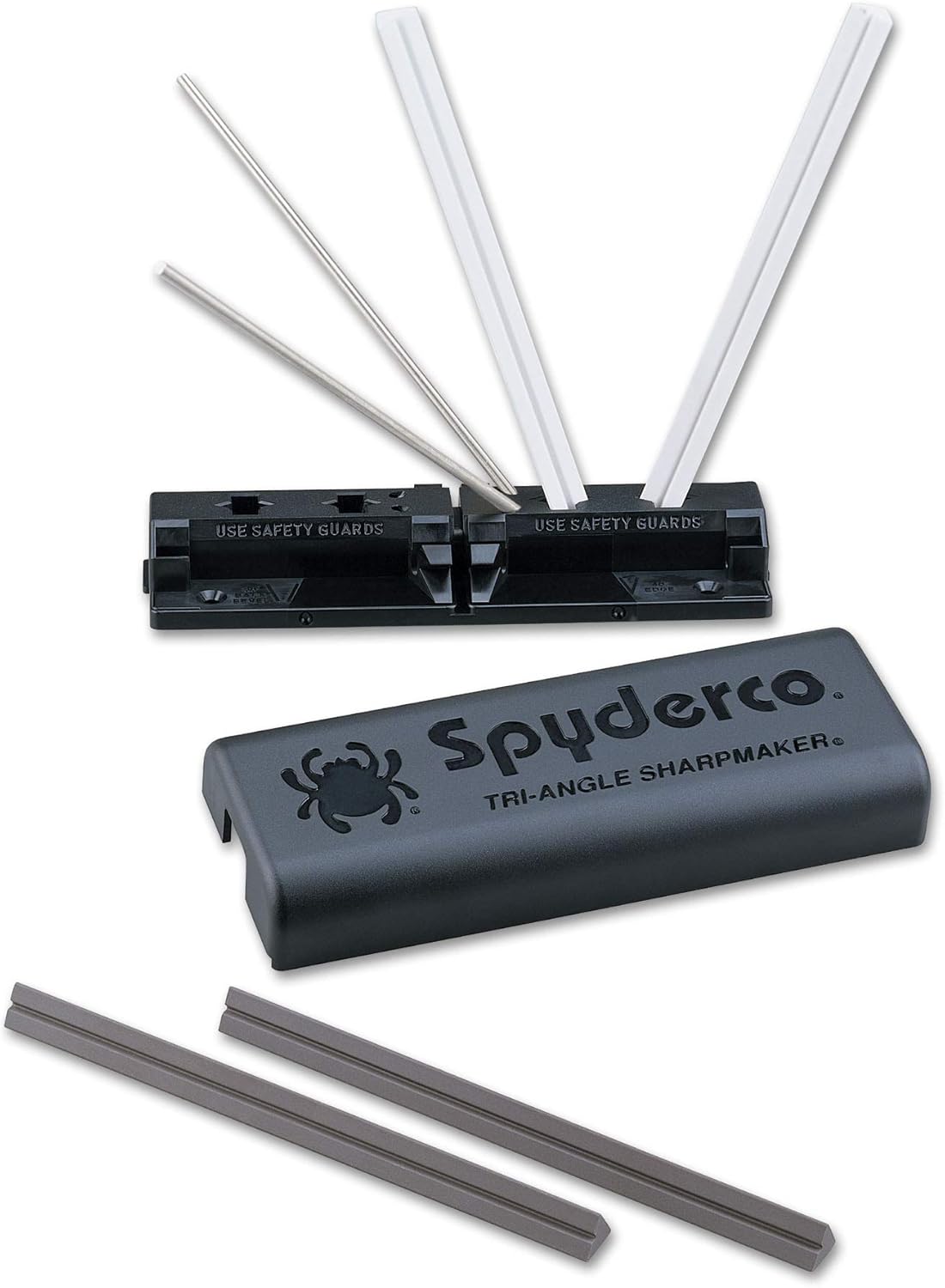
The Spyderco Sharpmaker has been in production for over 40 years for one reason: it just works. It’s not the sharpener you use to fix destroyed edges — it’s the one you use to keep sharp knives sharp.
- Design: Two sets of triangular ceramic rods (brown medium, white fine) that fit into a V-shaped base
- Two angles: 30 inclusive (15 per side) and 40 inclusive (20 per side)
- Usage: Hold the knife vertically and draw it down the rods — gravity and the base do the angle work
- Also handles: Serrated knives (use the corners of the triangle), scissors, fish hooks, and awls
The genius of the Sharpmaker is speed of setup and use. No clamping. No soaking. No adjusting angles. Pull it out of the base (where the rods store), pop the rods in, and you’re sharpening in 10 seconds. It’s perfect for “I need this knife sharper right now” moments.
Pros: Instant setup, handles serrations, excellent for maintenance, near-indestructible ceramic rods. Cons: Slow for heavy stock removal, limited to two angles, expensive for what it is.
Electric vs. Manual: The Verdict
Buy an Electric Sharpener If…
- You have 5+ knives to maintain regularly
- You value speed and convenience above absolute precision
- You cook daily and sharpening can’t be a weekend project
- You want consistent results without developing a skill
- Your knives are mostly Western-style (Henckels, Wüsthof, Victorinox)
Buy a Manual Sharpener If…
- You own Japanese knives (Shun, Miyabi, Masamoto) — they deserve precision
- You enjoy the craft of sharpening as much as the result
- You’re on a tight budget — $45 gets you a great manual system
- You want absolute angle control for different blades
- You’re building a skill that transfers to whetstones later
The Ideal Setup: Both
Here’s the truth most reviewers won’t tell you: many knife enthusiasts use both. An electric sharpener for quick maintenance and bulk work (Sunday meal prep, dull beater knives), and a manual guided system or whetstone for their nice Japanese blades and occasional precision sessions.
My honest recommendation: if you can budget for it, pair the Presto EverSharp ($40) for daily driver maintenance with the Lansky Deluxe ($45) for your nice knives. That’s ~$85 for a setup that handles every knife in your house — from the $12 paring knife to the $300 gyuto.
FAQs
Do electric sharpeners damage knives?
Quality electric sharpeners (Chef’sChoice, Work Sharp) do not damage knives when used correctly. They do remove more steel per sharpening than manual methods — which means your knife won’t last as many decades. Cheap electric sharpeners with coarse, non-diamond wheels can overheat edges or create uneven bevels. Stick to the brands recommended above.
Can I sharpen serrated knives with an electric sharpener?
Some, not all. The Chef’sChoice Trizor XV and Work Sharp Ken Onion handle serrations. The Presto EverSharp does not. For serrated maintenance, a tapered diamond rod is still the best tool (and costs $10–15).
How often should I replace the abrasive wheels/belts?
Diamond wheels (Chef’sChoice): They don’t wear out — the diamonds are embedded throughout. You’ll replace the entire unit before the wheels fail. Sapphirite/ceramic wheels (Presto): Expect 2–5 years of regular home use before performance declines. Abrasive belts (Work Sharp): Replace every 30–50 sharpenings, depending on pressure. Belts are consumables.
What’s the absolute best manual sharpener for beginners?
For guided systems: Lansky Deluxe 5-Stone ($45) is unbeatable value. For whetstones: Sharp Pebble Premium 1000/6000 ($40) includes everything. For maintenance: Spyderco Sharpmaker ($89) is dead simple and lasts forever. Avoid cheap carbide pull-throughs unless the knife cost under $20.
Is the Work Sharp Ken Onion too aggressive for kitchen knives?
On the lowest speed with a fine belt (P6000 or leather stropping belt), no — it’s gentle and produces excellent convex edges. The risk is user error: if you crank the speed and use a coarse belt on a thin Japanese knife, you can absolutely remove too much steel in one bad pass. Respect the tool and it respects your blades.
Are guided rod systems better than whetstones?
“Better” depends on your priorities. Guided systems (Lansky, Wicked Edge) give you perfect angles with zero skill — like training wheels that produce pro results. Whetstones give you infinite versatility and more control but require practice. A Lansky will match a decent whetstone user’s edge every time. It won’t match an expert whetstone user — but that takes years.
The Bottom Line
If I had to pick one sharpener to recommend to someone who just wants sharp knives and doesn’t want to think about it: get the Chef’sChoice Trizor XV. It’s an investment, but it’s the closest thing to “set it and forget it” in the sharpening world — and the 15 Trizor edge is genuinely superior to what comes from the factory on most knives.
If you’re on a budget and willing to spend 10 minutes per knife for better results: the Lansky Deluxe 5-Stone delivers precision at a price that’s hard to believe.
Either way — stop hacking at your food with a dull knife. You’re better than that. Your tomatoes deserve better than that.
Disclosure: As an Amazon Associate, bladeowl.com earns from qualifying purchases. All opinions are our own based on real-world testing and research.